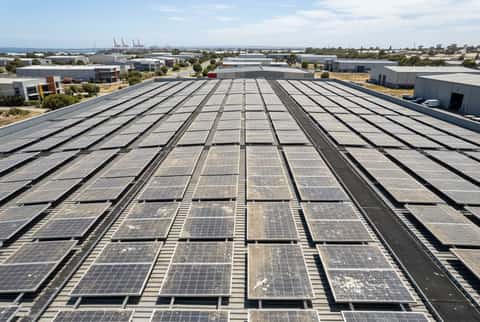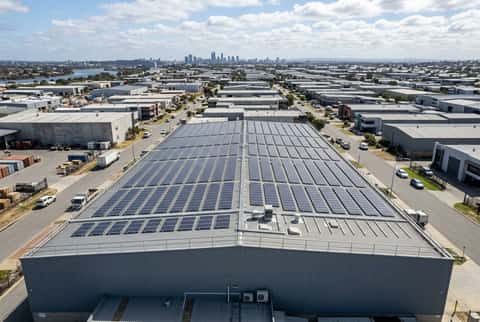
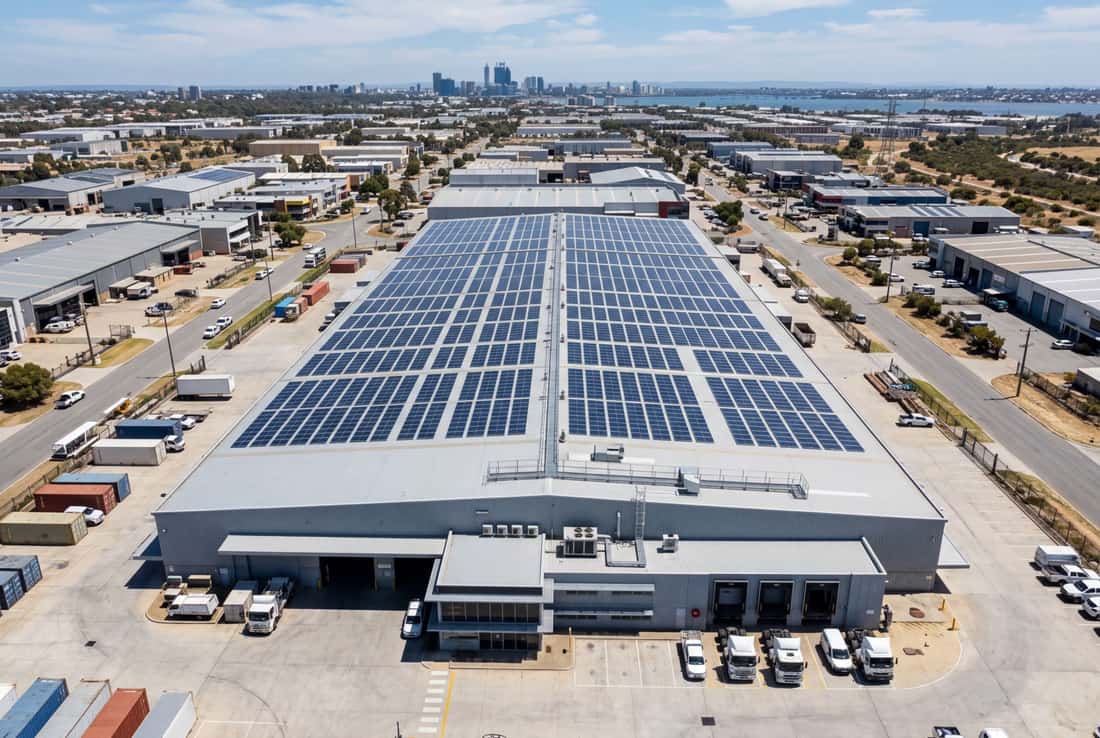
Warehouse solar panel cleaning in Perth comes with its own set of challenges. These roofs are often broad, low-profile, and highly exposed, which means they can collect a steady layer of dust and residue without drawing much attention from ground level. Because the array sits so far above daily operations, it is easy for cleaning to fall behind until the roof looks noticeably tired or someone finally sees the condition of the panels from a better vantage point.
That is why warehouse sites benefit from a more deliberate approach. Unlike a small office roof, a warehouse array can cover a large footprint and be affected by surrounding yards, truck movements, loading areas, and industrial activity. Cleaning is not just about making the panels look better. It is about managing a large commercial asset sensibly and keeping the roofline aligned with the standard of the wider premises.
Why warehouse roofs get dirty so easily
Large exposed roof areas
Warehouses generally have wide roof spans with limited shelter from wind-blown dust and debris. That makes it easier for residue to settle across the glass and harder to notice the change until the whole array has lost its clean appearance.
Nearby transport and yard activity
Many warehouse sites have frequent vehicle movement, open hardstand areas, or surrounding industrial activity that contributes to airborne dust. Even where the business itself is clean and organised, the wider environment still affects the roof.
Bird activity and roof edges
Large rooflines, parapets, service areas, and surrounding structures can all increase bird activity. On warehouse arrays, that often means visible marks in specific zones that stay in place until the panels are cleaned properly.
A lot of dirt builds gradually
The problem on warehouses is often not one dramatic event. It is the steady build-up that comes from exposure over time. That is why these roofs can become surprisingly dull before anyone reacts.
What businesses should think about on warehouse sites
Scale is the first issue. A warehouse roof may carry far more solar coverage than a standard office or small retail premises, which means cleaning needs to be approached as part of site maintenance rather than as a quick afterthought.
Access and timing also matter more. Warehouses often have loading schedules, delivery windows, staff movement, and operational constraints that make planning important. The benefit of a proper commercial service is that the work can be organised around the business instead of becoming a disruption.
Presentation should not be overlooked either. While customers may not inspect the roof directly, warehouse panels still form part of the site condition. A neglected array can make the property look less well managed, especially on cleaner, more modern industrial premises.
Where sites are trying to present a sharp, efficient image to clients or suppliers, roof cleanliness becomes part of that overall impression even if it is only noticed occasionally.
Why regular cleaning makes more sense than waiting
Large arrays look worse when neglected
The bigger the roof, the more visible the neglect becomes once residue builds up. A broad dusty array has a very different visual impact from a few dirty panels on a small site.
Routine is easier than sporadic catch-up
Businesses with warehouse roofs usually benefit from creating a repeat pattern once the first clean has reset the array. That prevents the common cycle of leaving it too long, reacting late, and then starting from scratch again.
It supports wider property standards
Warehouses that invest in clean yards, maintained glazing, tidy access points, and organised branding should apply the same logic to the solar array. It is part of the building and should be kept to a matching standard.
It makes future planning simpler
Once the business knows how quickly the roof tends to lose its clean appearance, future cleaning is easier to schedule and budget for.
Perth warehouse sites need a local commercial approach
Purified Group’s live site positions the business as a Perth exterior cleaning provider serving residential and commercial properties, and it supports solar cleaning with service pages for industrial areas such as Bibra Lake, Jandakot, Welshpool, Henderson, and Canning Vale. That type of service footprint suits warehouse work because these properties need a contractor that understands commercial conditions rather than treating the roof as if it were a simple domestic clean.
For warehouse operators, the goal is not just to react when dirt becomes obvious. It is to create a maintenance standard that keeps the roof looking managed and avoids long gaps where build-up quietly becomes normal. That is usually easier once the first clean has taken place and the business can judge how quickly residue returns.
Why warehouse arrays deserve their own maintenance standard
A warehouse roof often carries a larger share of the property’s visual mass than people realise. Once the array loses its clean appearance, the building can feel more tired overall, even if the yard and frontage are otherwise in good order.
That is why warehouse solar panel cleaning should be treated as its own commercial upkeep issue rather than folded into a vague “we will deal with it later” mindset. A proper clean gives the site a reset and makes the next decision easier.
A warehouse roof needs a proper commercial maintenance mindset
If your warehouse solar panels have been left until they are visibly dusty or patchy, the schedule is probably too loose. A proper clean gives the site a reset and makes future maintenance much easier to manage.
See Commercial Solar Panel Cleaning for broader service details or go back to the Purified Group homepage. For industrial-area service pages, view Bibra Lake or Canning Vale.
What businesses often get wrong with warehouse arrays
A common mistake is assuming that because the roof is out of the normal eyeline, it can be left longer without consequence. In practice, that usually just means the decline is noticed later. By the time the panels are clearly looking poor, the array has already spent a long period carrying unnecessary grime.
Another mistake is lumping warehouse roofs into the same maintenance rhythm as smaller commercial buildings. The exposure, scale, and surrounding operations are usually very different. A warehouse array often needs its own schedule based on how the site actually behaves rather than what seems convenient on paper.
Frequently Asked Questions
Why do warehouse roofs foul faster than other commercial sites?
Large flat warehouse roofs sit exposed to freight traffic dust, loading dock activity, and often bird activity around eaves and roof penetrations, all of which settle on the array faster than at a typical office site.
Can the SolarCleano F1 robot handle a large warehouse array?
Yes, it is built for exactly this scale, tracking consistently across large flat industrial roofs without the uneven pressure a manual clean can introduce over a big array.
Do you provide documentation for warehouse facility managers?
Yes, every commercial visit includes before-and-after photography and a service record covering the date, scope and any observations from the pre-clean inspection.