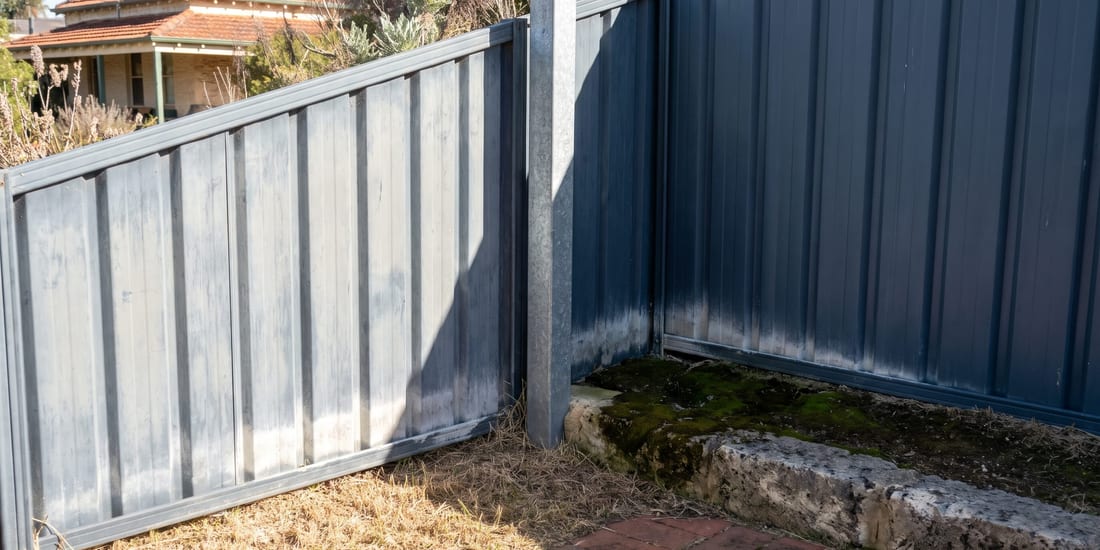
Colourbond fencing is everywhere in Perth for good reason. It handles the sun, it does not rot, and it goes up fast. What it does not do is stay clean. Within a year or two most fence lines in this city pick up something: a chalky white film along the bottom, orange streaks in a fan shape where a sprinkler hits, a grey dullness on the western side, or green growth in the shade down the side passage.
Most online advice on cleaning Colourbond fencing is written for nowhere in particular. It says use a soft brush and mild detergent, which is fine as far as it goes, and completely misses the three things that actually mark fences in Perth. Here is what causes the staining locally, how to clean the panels without wrecking the finish, and why the fix usually starts with your reticulation rather than your bucket.
Why Perth conditions stain Colourbond differently
Bore water and reticulation minerals
Groundwater across much of the Swan Coastal Plain carries dissolved iron and calcium. When that water lands on a fence panel and dries in the sun, the water goes and the minerals stay. Iron oxidises into the familiar orange or rust-brown streak. Calcium leaves a chalky white crust that feels gritty under your fingertips.
This is the most important distinction for anyone cleaning a Colourbond fence here: it is not dirt. Dirt sits on top of the paint and lifts off with detergent and a rinse. Mineral deposits bond to the surface and keep building in layers every time the sprinklers run. Scrubbing harder will not break that bond, it will just polish the paint unevenly. Mineral staining needs a product that dissolves the deposit chemically, then a thorough rinse.
Salt air in coastal suburbs
If you are anywhere in the band from Mandurah up through Fremantle, Cottesloe, Scarborough, Hillarys and north to Yanchep, your fence is collecting airborne salt. Salt is hygroscopic, meaning it pulls moisture out of the air, so a salted panel stays damp longer than a clean one. That extended wet time is what accelerates coating wear and lets corrosion start at cut edges, screw holes and the bottom rail where the steel meets soil. The faintly tacky surface salt leaves behind also holds dust in place, which is why coastal fences often look grubbier than inland ones.
Dust from the easterlies
Perth’s summer easterlies carry fine inland dust and ash, and they deposit it on the eastern face of every fence line in the city. On its own, that layer washes off easily. The problem is the combination. Dust plus overnight dew plus sprinkler overspray creates a damp mineral and grit paste that sits against the paint. Left through a full summer, that paste is what produces the dull, slightly chalky look people often mistake for faded colour.
Fix the water source before you clean anything
This is the step almost every guide skips, and it is the reason so many people clean their fence twice a year and still never get ahead of it.
Walk the fence line while your reticulation is actually running. Not from the kitchen window, stand there and watch each station. You are looking for any head throwing water directly onto a panel, any arc that has drifted out of adjustment, any pop-up that is too tall for the bed it sits in, and any mist drifting onto steel in the afternoon breeze.
If a sprinkler is hitting the fence three mornings a week on bore water, you are depositing a fresh layer of iron and calcium onto that panel over a hundred times a year. No cleaning product keeps up with that. Adjust the arc, lower the head, change to a nozzle with a tighter pattern, or move the head further into the garden bed.
The same logic applies to any surface the bore water reaches. Limestone walls, paving, render and rooftop solar all accumulate the same deposits, which is why Purified Group’s Perth solar panel cleaning service so often deals with panels dulled by reticulation overspray rather than ordinary dust.
Sort the water source first. Then clean. Otherwise the staining is back within weeks and you have spent an afternoon for nothing.
Correct technique for painted steel fencing
Colourbond is steel with a layered paint system baked onto it. That paint system is what provides the colour, the UV stability and the corrosion protection. Everything about safe cleaning comes down to not damaging it.
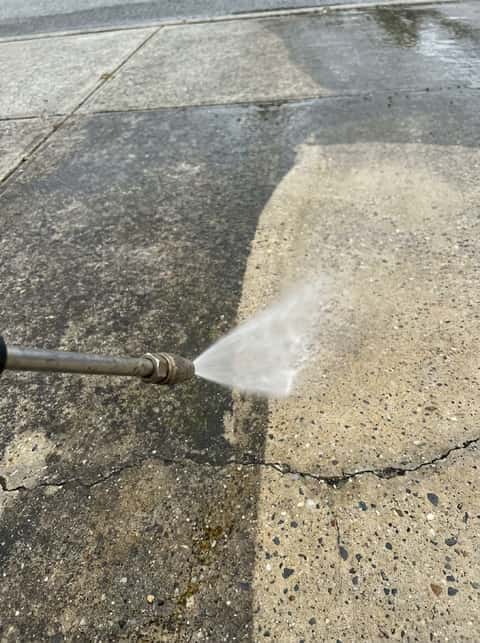
Pressure. Keep well below the levels used on concrete. As a working guide, stay under roughly 1200 to 1500 PSI at the fence, and go lower if the coating is older or already chalky. Domestic machines commonly run at double that, so either use the pressure adjustment, step back, or fit a wider nozzle to reduce the force hitting the surface.
Nozzle. Use a wide fan, 40 degrees or wider. A 40 degree white tip or a dedicated soft wash nozzle spreads the force across a broad area. Never use a turbo or rotary tip on a fence panel. Those tips concentrate the whole output into a spinning point and will visibly scar painted steel in seconds.
Distance. Keep the nozzle at least 300mm to 400mm from the panel and keep it moving. Holding the wand still is what creates the clean streak that never blends back in.
Direction. Work top to bottom so dirty runoff flows over surfaces you have not cleaned yet, and angle the spray slightly downward rather than straight on. Spraying upward under a capping or rail pushes water into the join, where it sits against bare cut edges and causes rust from the inside out.
Method. The best results come from a soft wash sequence rather than brute force. Wet the panel down, apply a suitable detergent or mineral treatment, give it the dwell time on the label, agitate gently with a soft brush where needed, then rinse at low pressure. Work on a cool, shaded surface. Chemical that dries on hot steel can stain worse than what you were trying to remove.
If you are weighing up how hard to push a pressure washer generally, the same balance between result and surface damage applies to your paving and driveway, covered in our guide on how often you should pressure clean your driveway in Perth.
How to tell if the coating is already damaged
Before you start, it is worth knowing whether you are looking at dirt or at damage, because no amount of cleaning will fix the second one.
Wipe a small test patch with a damp cloth and a little detergent. If the area comes up noticeably brighter than its surroundings, you have dirt and the fence will clean up well.
If the cloth comes away with a fine coloured powder on it, that is chalking. The paint binder has broken down under UV and the pigment is releasing. Chalking is common on older, sun-facing panels and it cannot be reversed by washing, though a gentle clean does remove the loose powder and improve appearance for a while.
Look for a patchy, blotchy appearance where some areas are glossier than others, particularly in horizontal bands or narrow streaks. That pattern usually means someone has previously cleaned with too much pressure held too close, which has polished or abraded the surface unevenly.
Check the cut edges, the bottom of the panels and around fixings for rust bleed. Once corrosion has started at an edge, cleaning is a holding measure. The panel needs sealing or replacing.
Where nanocoating fits
Once a fence is properly clean, the surface can be treated with a protective nanocoating. These products form an extremely thin hydrophobic layer that sits over the existing paint system and changes how water behaves on it.
The practical benefit in Perth is specific. Water beads and sheets off rather than clinging and evaporating in place, so fewer dissolved minerals are left behind. Dust and salt have less to key into. The staining that does form sits more loosely on top of the coating and releases with a far gentler wash.
Nanocoating is not permanent and it does not make a fence self-cleaning. What it does is stretch the interval between washes and make each wash gentler, which over several years means less cumulative wear on the paint underneath.
Cleaning frequency by exposure
Fence lines on the same property can need very different schedules, so set a frequency for each run rather than for the property as a whole.
Shaded and south-facing panels: every three to six months. These stay damp longest and are where mould, algae and that green organic film take hold. The risk here is not sun damage, it is biological growth.
Sun-facing panels, north and west: once or twice a year. Dust and UV are the issues, and the coating on these runs is ageing fastest, so use the gentlest method that works and check regularly for chalking.
Coastal suburbs: every three months as a minimum, and more often if you are within a couple of streets of the beach. Even a plain fresh water rinse between proper cleans removes salt before it can do much.
Inland suburbs on mains water: annually is usually enough, often timed for after the summer easterlies have finished depositing dust.
Anywhere on bore water reticulation: go by what you see rather than the calendar. Once mineral deposits build into visible layers they are far harder to remove, so dealing with them early beats waiting for a scheduled clean.
Getting it right the first time
Cleaning a fence well is less about effort and more about diagnosis. Work out whether you are dealing with dirt, minerals, salt, organic growth or coating failure, fix whatever is putting water on the panel, then use the lowest pressure that does the job.
If you would rather not guess at pressures and products, or you want the surface protected afterwards so it stays clean longer, get in touch with the Purified Group team for advice on your property and its exposure.
Frequently Asked Questions
Can you pressure wash a Colourbond fence?
Yes, but only at low pressure with a wide fan nozzle held well back from the panel. High pressure at close range can dull the paint finish, drive water behind cappings and force grit under the coating. A soft wash approach using detergent and a gentle rinse is safer and usually more effective on mineral staining.
What removes bore water stains from a Colourbond fence?
Bore water stains are mineral and iron deposits, not dirt, so detergent alone rarely shifts them. They need a product formulated to dissolve iron and mineral scale, applied to a cool surface, kept wet for the dwell time and rinsed thoroughly. Scrubbing hard or blasting with pressure tends to damage the finish before it removes the stain.
How often should a Colourbond fence be cleaned in Perth?
As a general guide, inland fence lines in clean mains water areas are fine with a wash once a year. Coastal suburbs, bore water areas and shaded south-facing panels usually need attention every three to six months to stop salt, minerals and organic growth building into something harder to remove.
Will cleaning my fence void the warranty?
Regular gentle washing is part of normal care for prepainted steel and is generally expected. What can cause problems is abrasive scrubbing, harsh solvents, acid left to dry on the surface or high pressure held close to the panel, all of which can damage the paint system. Check the manufacturer’s care guidance for your product before using any strong chemical.
Does fixing my reticulation really stop the stains coming back?
In most cases it is the single most effective thing you can do. If a sprinkler head throws bore water directly onto the fence several times a week, the mineral staining will return within weeks of any clean. Adjusting arcs, lowering heads or swapping to a different nozzle pattern removes the cause rather than repeatedly treating the symptom.