
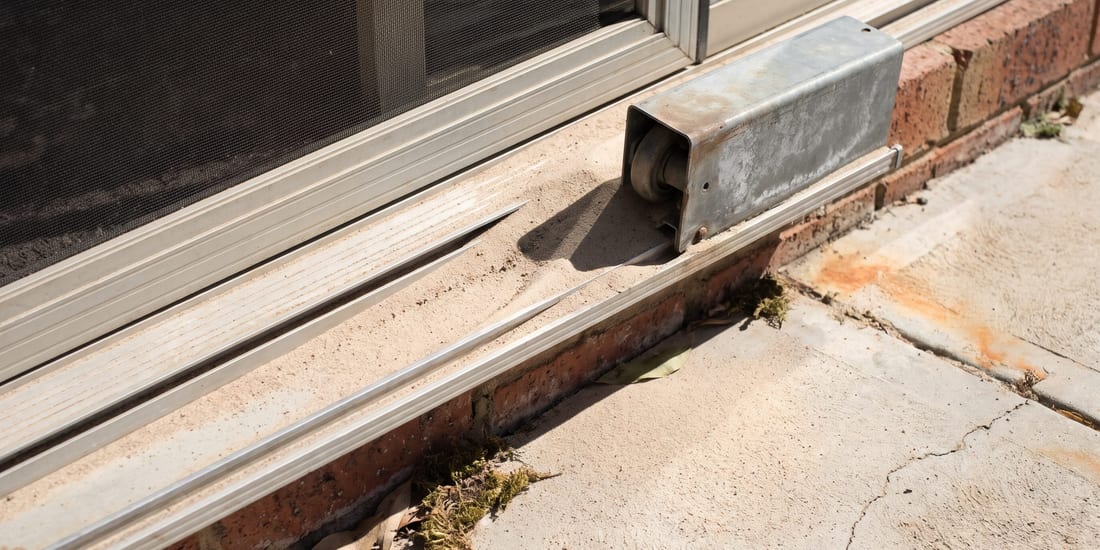
Anyone who has lived through a Perth summer knows the sound. You go to slide the back door open on a January evening, and instead of gliding, it grinds. There is a gritty crunch underfoot in the track, the door needs a shoulder behind it, and a fine tan line of sand has built up in the channel like a miniature dune.
That sand did not fall there. It was driven there, and the mechanism matters, because it explains why tracks fill up faster than the glass above them gets dirty, and why ignoring them costs more than it looks like it should.
Why Perth pushes sand into tracks specifically
Three things combine here, and they combine badly.
The first is the wind itself. Perth’s summer pattern gives you hot, dry easterlies through the morning that sweep in off inland sand and bare paddock, followed by the Fremantle Doctor in the afternoon carrying fine coastal particulate the other way. Most of the year, a window frame is being hit from two different directions by air that is carrying something abrasive.
The second is the ground cover, or the lack of it. Large parts of the metro area sit on Bassendean and Spearwood sands, which are loose, pale and easily lifted. Add a newly developed estate where lots are still bare, a neighbour mid-renovation, or limestone retaining and crushed limestone driveways, and there is a constant supply of fine particles at ground level with nothing holding them down.
The third is simple physics at the building. Wind hits a wall, slows, and drops what it is carrying. The heaviest particles fall first and lowest. A window track is a horizontal channel at exactly the height where that deposition happens, with a lip on either side, which makes it a near-perfect trap. Rain washes the glass. Rain mostly does not wash the track, because the track is shielded by the frame and the overhang above it, and whatever water does get in drains through weep holes while the sand stays behind.
So you get a situation where the glass looks only moderately dusty but the track below it is packed. The glass is a vertical surface with runoff. The track is a horizontal gutter with a roof over it.
What trapped grit actually does to a sliding door
Sand in a track is not a cosmetic problem. It is an abrasive sitting in a bearing surface.
Sliding windows and doors run on small rollers, usually nylon or steel, that are designed to contact the track along a narrow strip. When sand sits in that strip, every slide drags hard particles between the roller and the aluminium. Over hundreds of cycles, three things happen in sequence.
The rollers wear first. Nylon wheels develop flat spots and grooves where grit has been crushed into them, and once a wheel is no longer round, the door feels notchy and heavy even on a clean track. Steel rollers fare better but can seize if grit works into the bearing.
Then the track wears. Aluminium is soft. A loaded roller grinding sand along the same path will, over years, cut a shallow channel into the track face. Once that channel exists, the door sits lower, the rollers no longer carry the load evenly, and you cannot adjust your way out of it properly. Replacing a worn track is a much bigger job than replacing rollers.
Last, the seals go. The brush pile and rubber seals around a sliding panel are there to stop draughts, dust and water. Grit abrades the pile, shortens the fibres and tears the rubber at the contact points. A degraded seal lets more sand into the track, which accelerates everything above it. That is the loop that turns a minor maintenance task into a repair bill: more grit, worse seals, more grit again.
There is a safety element too. A heavy sliding door that needs real force to move is a problem for older residents and for anyone carrying something. Plenty of people stop using a back door entirely because it has become a two-handed operation.
Sand, dust or bore water: telling them apart
The fix is different for each, so it is worth a moment’s diagnosis before you reach for anything.
Sand and coastal grit is loose, granular and visibly textured. It moves when you brush it and it crunches under a fingertip. Colour ranges from pale grey to tan depending on your suburb. It is heaviest in the track corners and at the ends of the run.
General household dust is finer, greyer and more uniform, often mixed with lint, hair and insect debris. It compacts into a soft felt rather than a gritty layer, and it is more common on windows that are rarely opened.
Bore water residue looks completely different once you know it. It presents as an orange, rust-brown or chalky white film that is bonded to the surface, not sitting on it. Brushing does nothing. It appears in streaks and arcs matching the throw pattern of a sprinkler, and it will be on the glass and the frame as well as in the track. The iron and mineral content in Perth’s groundwater deposits and then oxidises, and the only thing that shifts it is a suitable mild acidic treatment, correctly dwelled and neutralised, not mechanical scrubbing.
Many Perth homes have all three in the same track: sand in the channel, dust in the corners, bore staining on the face of the frame. Clear the loose material first, then assess what is actually bonded underneath.
A safe method for clearing tracks
The goal is to remove abrasive material without using anything more abrasive than the material you are removing. Aluminium and powder coating scratch easily, and a scratch gives sand somewhere new to lodge.
Dry first, always. Do not wet a sand-filled track. Adding water turns loose grit into a paste that you then have to scrape, which is exactly where damage happens. Start by vacuuming with a crevice tool, working along the whole run including under the open panel. Slide the panel to the other end and vacuum the section it was covering.
Loosen what the vacuum missed. A stiff nylon brush, an old toothbrush or a dedicated track brush will lift compacted grit out of the corners and from behind the lip. Work along the track rather than across it, then vacuum again. Do not use a wire brush, a metal scraper or a knife blade. Do not use a drill-mounted brush.
Then go damp. Once the loose material is gone, wipe with a cloth dampened in warm water with a small amount of neutral pH detergent. A folded microfibre pushed along with a blunt plastic tool reaches the base of the channel. Change the cloth face often so you are not dragging recovered grit back through.
Deal with the weep holes. Those small slots at the bottom outer edge of the track are the drainage path. Blocked weep holes mean water pooling in the track, which accelerates corrosion and makes sand set like mortar. Clear them with a soft pipe cleaner or a short burst of compressed air from outside, never by forcing a sharp tool through.
Dry it, then leave it dry. Wipe the track out properly. Resist the temptation to spray oil or general purpose lubricant in there. Oil is a sand magnet and will give you a far worse problem by next season. If the rollers genuinely need lubrication, a dry PTFE or silicone product applied sparingly to the rollers themselves, not flooded into the channel, is the right approach.
What not to use: pressure washers (they drive water into the wall cavity and lift coating edges), steel wool, scouring pads, bleach, and solvent-based cleaners that attack rubber seals and powder coating.
Where DIY stops
There are a few situations where a vacuum and a toothbrush are not the answer.
If the track has been neglected for years, the bottom layer may be cemented in place by a mix of sand, moisture and organic matter. Attacking that with hand tools is how tracks get gouged. It needs proper extraction and controlled chemistry.
If the seals are already perished, cleaning the track treats the symptom. Brittle, flattened or torn pile and rubber need replacing, and that is a glazier or door specialist’s job, not a cleaning task.
If the door still drags after a thorough clear-out, the damage is already in the rollers or the track face. Keep cleaning and the wear continues. Get it assessed.
And if there is bonded bore water staining on the frames and glass, that is a treatment issue with its own risks. The wrong product on powder coating, anodised aluminium or a sealed sill causes permanent marking. This is also where the method used on the glass above matters, and it is worth understanding why pure water window cleaning differs from traditional methods before deciding how to tackle the whole opening.
Make it part of the routine, not an emergency
The most common pattern is a homeowner who never thinks about tracks until a door stops working, by which point the rollers are finished and the seals are gone. Treated as scheduled maintenance instead, it is a small, cheap task.
Tracks are best cleared at the same time as the glass, for the obvious reason that whoever is cleaning the window is already at that opening with the panel accessible. Doing it in one visit also means the dust and run-off from the glass clean is removed rather than settling into a track you cleared last month. Two or three times a year suits most Perth homes, with coastal properties, homes near bare blocks and anywhere running bore reticulation at the higher end of that range.
If your tracks are already past the vacuum-and-brush stage, or you would rather it simply came with the clean, have a look at what Purified Group’s Perth window cleaning covers and ask for tracks and sills to be included in the scope.
Frequently Asked Questions
How often should window tracks be cleared in Perth?
Most homes do well with a clear-out two to four times a year, with coastal and newly developed suburbs at the higher end. If a sliding door has started to feel heavier than it did last month, that is your prompt regardless of the calendar.
Can I use a pressure washer on window tracks?
It is not worth the risk. High pressure drives water past weep holes and seals into the wall cavity and the frame, and it can lift powder coating at the edges. Dry removal first, then a damp wipe, gets the same result without the damage.
Is the white crust in my tracks sand or bore water?
Sand is loose and gritty and moves when you brush it. Bore water residue is a bonded orange or white film that stays put and needs a mild acidic treatment, not scrubbing. Tracks near a reticulated lawn often have both.
Will clearing the track fix a sliding door that sticks?
Sometimes. If grit is the only problem, clearing it often restores smooth operation immediately. If the rollers are already flat-spotted or the track has worn a groove, the door will still drag and needs repair or adjustment.
Do window cleaners clear tracks as part of a visit?
Many do, and it is far cheaper folded into a scheduled clean than called out as a separate job. Ask what the quote covers, since track and sill work is not always included by default.