
If you have searched the term, you have probably found two kinds of results: chemistry papers written for materials scientists, and shopping listings for spray bottles promising showroom glass forever. Neither tells a homeowner what they actually want to know, which is whether this is a real solution to the film that keeps reappearing on their windows or just another product.
Here is the plain version, with Perth conditions in mind.
What nanocoating actually is
Glass looks perfectly smooth. Under magnification it is not. The surface carries microscopic pores and irregularities, and those tiny hollows are exactly where dirt, salt, minerals and airborne grime settle. Ordinary cleaning removes what sits on top. What has worked its way into the surface texture stays, which is why some windows never quite come up properly no matter how hard you scrub.
A nanocoating is an extremely thin treatment, measured in nanometres, that bonds chemically with the glass and fills those pores. The coating is not a film laid over the top in the way car wax sits on paint. It becomes part of the surface, creating a layer that is both smoother and hydrophobic, meaning it repels water rather than letting it spread.
The practical effect is visible the moment it rains. Instead of sheeting across the pane and drying into streaks, water pulls into beads and rolls off, carrying loose dirt with it. Less contact time between water and glass means less opportunity for anything dissolved in that water to be left behind.
Why Perth glass takes more punishment than most
Every city is hard on windows in some way. Perth manages to combine three separate problems, and the combination is what makes glass here deteriorate faster than owners expect.
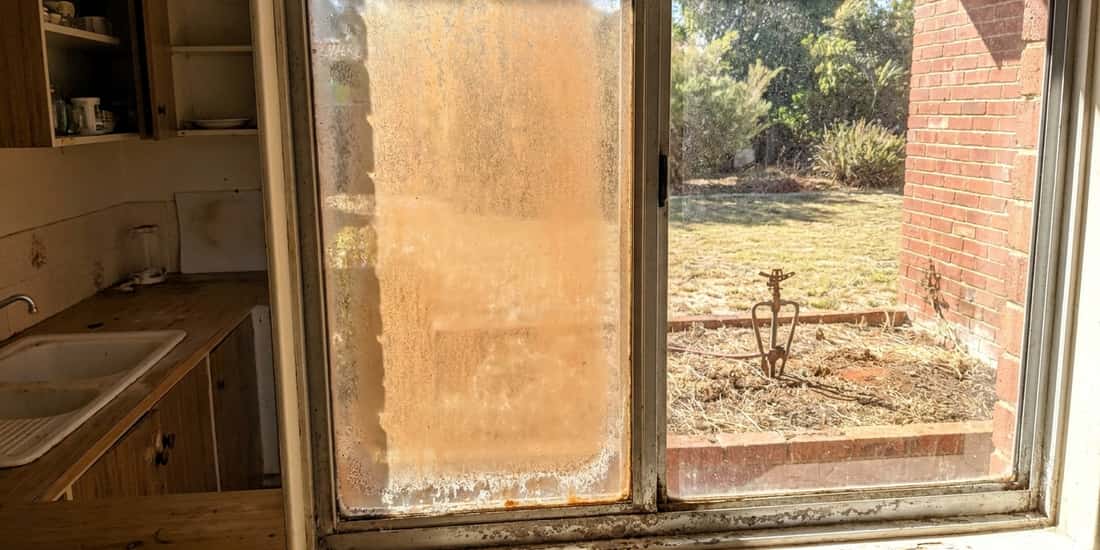
Bore water. Scheme water is one thing. Bore water is another entirely. It carries dissolved iron and mineral content, and when a reticulation head throws it against a window at six in the morning, the water evaporates in the sun and the minerals stay. Repeated hundreds of times over a season, this is not surface dirt. Iron staining bonds into the glass and eventually etches it. Homeowners often describe it as a rusty orange haze that no amount of cleaning shifts, and by that point they are right, because the damage is in the glass rather than on it.
Coastal salt. Anywhere within reach of the sea breeze gets a steady deposit of airborne salt. Salt is hygroscopic, meaning it attracts moisture, so a salted window collects a damp film that grabs dust and holds it. It also accelerates corrosion on frames, hinges and flyscreen mesh, which is why coastal windows tend to look tired well before inland ones of the same age.
Ultraviolet and heat. A long, bright summer bakes whatever is sitting on the glass. Mineral deposits and organic grime that might be rinsed away in a cooler climate instead dry hard, repeatedly, and become progressively more difficult to remove. Heat also shortens the life of anything sacrificial on the surface, which matters when comparing product grades.
Nanocoating is not a Perth invention, but it earns its place here because these three conditions all attack glass in the same way: by leaving something on the surface long enough to bond with it. A treatment that stops things bonding in the first place addresses the actual mechanism rather than the symptom.
What a coating changes day to day
Expectations matter more than chemistry here, so it is worth being specific about what you notice.
Windows stay presentable for longer between cleans. Dust and salt still land, but they sit loosely rather than keying into the surface, so a rinse does far more than it used to. When the glass is cleaned properly, it comes up faster and with less effort, because the cleaner is not fighting bonded deposits. Water marks from reticulation overspray are far less likely to become permanent, since the droplets bead and run rather than spreading and drying in place.
Owners with shower screens often notice the change most sharply, because soap scum and hard water film have nowhere to grip.
What it does not do
An honest guide has to include this part.
Nanocoating is not self-cleaning. Anyone promising windows you never touch again is selling something. Glass still needs washing, just less often and with much less effort.
It does not repair damage that has already happened. If bore water has etched the surface, a coating applied over the top seals the staining in rather than lifting it. Restoration comes first, coating second. This is the single most common reason people conclude the technology does not work, when what actually happened is that it was applied to the wrong starting condition.
It is not permanent. Coatings wear. Exposure, orientation, abrasion and the products used for subsequent cleaning all affect how long the treatment performs. Harsh chemical cleaners and abrasive pads shorten its life considerably.
DIY kits versus professional application
Retail nanocoating sprays exist and dominate a lot of search results. They are not fraudulent, and on a small, sheltered, already-clean surface they can do a reasonable job. The gap between them and professional treatment is less about the bottle and more about everything surrounding it.
Preparation. A professional application starts with full restoration of the glass, which may mean mineral removal or mechanical polishing to take etching out of the surface. Nothing bonds properly to contaminated glass. A consumer spray applied over a faint mineral haze is essentially laminating the haze in place.
Product grade. Trade formulations are generally more durable and more demanding to apply than the consumer versions, which are deliberately formulated to be forgiving of user error. Forgiving usually means less aggressive bonding.
Conditions and technique. Coatings are sensitive to temperature, humidity and application timing. Applying in direct Perth summer sun on a hot pane is a reliable way to get streaking and patchy coverage. Even application, correct dwell time and proper levelling all affect the finish.
Curing. The coating needs undisturbed time to bond. Rain, reticulation or an enthusiastic wipe during the curing window undermines the result, and most DIY failures trace back to exactly this.
Coverage. Two storeys of glass, fixed picture windows and awkward access are a different proposition to a bathroom screen. Reaching every pane evenly, safely and consistently is its own skill.
If you are weighing it up, the useful question is not which product is best. It is whether your glass is in a condition to accept a coating at all, and whether you can control the application environment.
Keeping the coating working
A coating changes the cleaning method you should use afterwards. Abrasive scourers, ammonia-heavy sprays and aggressive commercial glass chemicals wear the treatment down faster than the weather does.
The gentlest effective approach is pure water. Deionised or filtered water has had its dissolved minerals removed, so it lifts dirt and then dries without leaving anything behind, and it does so without detergents that attack the coating. That pairing (a coated surface plus a mineral-free rinse) is why the two are so often recommended together. There is a fuller explanation of the method in our guide to pure water window cleaning versus traditional methods, and it is worth reading if you are also rethinking how your windows are cleaned generally.
Beyond that, maintenance is unremarkable. Regular gentle washing, prompt rinsing after heavy salt or bore water exposure, and no harsh chemicals.
Who benefits most
Coating pays off hardest where exposure is highest and access is worst. Coastal homes with large glazed frontages. Properties on bore water reticulation where overspray is unavoidable. Two-storey windows nobody wants to clean twice as often as necessary. Frameless shower screens, which look superb when new and dreadful once hard water film sets in. Glass balustrades around pools, which take chlorinated splash and salt together.
For a small, sheltered inland home with modest glazing, the case is weaker and there is no shame in saying so.
If your windows already carry staining that will not shift, the sequence matters: restore first, then protect. That is the approach behind Purified Group’s nanocoating treatment, and it is worth an honest assessment of your glass before anyone quotes you on a coating.
Frequently Asked Questions
What is nanocoating for glass in simple terms?
It is an ultra-thin protective layer applied to the surface of glass. It bonds with the glass itself rather than sitting on top like a wax, filling the microscopic pores that dirt and minerals normally lodge in. The result is a smoother, water-repellent surface that stays cleaner for longer and is easier to wash.
Does nanocoating stop bore water staining?
It makes bore water far less damaging because mineral-heavy droplets bead and run off instead of spreading and drying in place. It is not a force field, though. Glass hit by reticulation every second morning will still need washing, but the staining is much less likely to bond permanently into the surface.
Is a DIY nanocoating kit as good as a professional application?
Generally no, and the main reason is preparation rather than the bottle itself. Professional coatings are applied to fully restored glass in controlled conditions, with attention to curing time. A retail kit sprayed over glass that already carries mineral etching simply seals the problem underneath.
How long does nanocoating last on glass?
Lifespan varies with exposure, the grade of product used and how the glass is cleaned afterwards. West-facing coastal glass wears faster than a sheltered courtyard window. Ask any provider what they state for their specific product rather than relying on a general figure.
Can nanocoating be applied to surfaces other than windows?
Yes. The same principle applies to shower screens, glass balustrades, splashbacks and some hard surfaces such as tiles and stone. The chemistry differs by substrate, so the product used on a pool fence is not necessarily the one used on a bathroom screen.