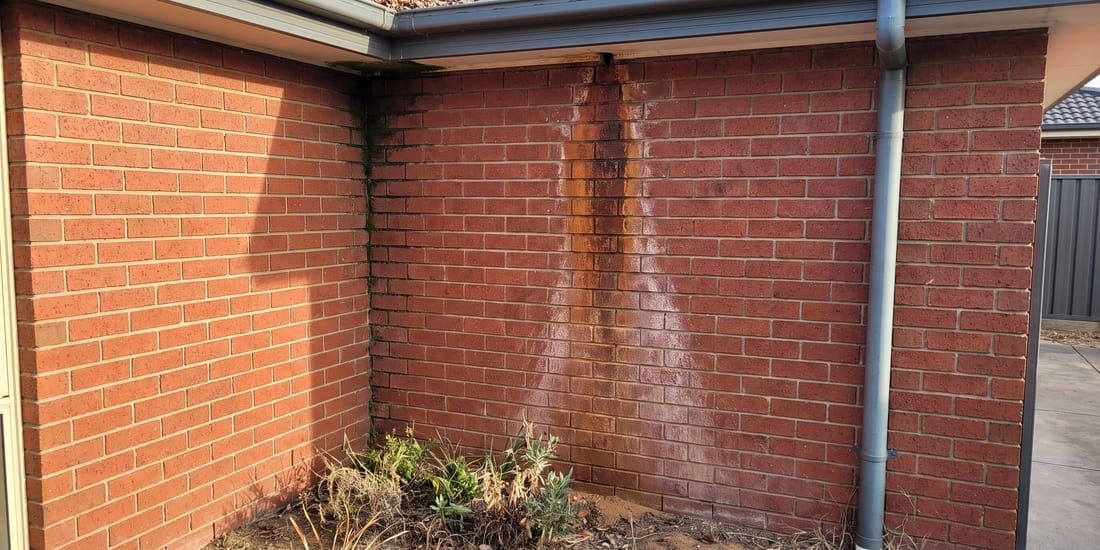
You notice it from the driveway, usually in the afternoon light. A dark band running down the brick, always in the same place, always under the gutter. Maybe it is a narrow streak. Maybe it is a broad mottled patch. Either way it was not there a couple of summers ago, and no amount of hosing seems to shift it.
A brick wall stained under the gutter line is not just a cosmetic nuisance. It is a diagnostic signal. The wall is telling you where water is going that it should not be going, and the shape, colour and position of the mark narrows down the cause considerably. Get the diagnosis right and the fix is straightforward. Get it wrong, scrub the wall and walk away, and the stain will be back by next winter.
Here is how to read it.
Start by reading the stain pattern
Before you touch the wall, stand back and look at the shape of the mark. Three broad patterns cover most Perth homes.
Vertical streaks running straight down. If the stain starts high, right at the gutter line, and runs down in defined lines or a single wide band, you are almost certainly looking at overflow. Water is coming over the front or back edge of the gutter, or escaping through a failed joint, and it is tracking down the same path every time it rains. Overflow stains are usually darker at the top and taper or fan out lower down. You will often see a matching mark on the paving or garden bed directly below.
Patchy, mottled, green or black growth. This is biological. Algae, lichen and mould take hold where a surface stays damp and shaded. South facing walls, narrow side passages and areas screened by dense shrubs are classic locations. The giveaway is that the mark does not follow a neat line downwards. It spreads outwards in irregular blotches and is often slightly furry or slimy when wet. It can still be caused by gutter overflow keeping the wall damp, so the two problems frequently overlap.
Orange, rust or tan coloured staining. This one is very Perth. Iron rich groundwater leaves a distinctive orange brown deposit on anything it repeatedly wets. If the colour is warm and rusty rather than grey or green, and if the stain is heaviest near the bottom of the wall and fades as it climbs, the cause is far more likely to be at ground level than at roof level.
A quick test: go out during or just after heavy rain and watch the wall. Overflow shows itself immediately. If the wall stays dry in a downpour but the stain is still there, your gutter is probably not the culprit.
Why Perth gutters overflow in the first place
Perth roofs collect a particular kind of debris, and it is unkind to gutters.
Eucalypts shed constantly rather than seasonally. The narrow gum leaf is the worst possible shape for a gutter, because the leaves lie flat, pack tightly and form a dense mat that water cannot pass through but which looks almost like nothing from the ground. Add gum nuts and bark strips and you have a blockage that builds slowly and silently.
Jacarandas, which line so many older suburban streets, drop a heavy load of flowers and fine leaflets in late spring. That material breaks down quickly into a sludgy organic layer. Once it settles into the gutter base it holds moisture, encourages corrosion and, crucially, chokes the downpipe outlets. Pine needles do something similar and are even better at wedging themselves into outlet gratings.
Then there is the design issue. Plenty of Perth homes have gutters and downpipes sized for average rainfall, not for the short, violent bursts that arrive with a winter front or a summer thunderstorm. When fifteen minutes of intense rain hits a roof plane that drains to a single undersized outlet, the gutter fills faster than it can empty. Even a clean gutter will spill in those conditions. A partly blocked one spills every single time.
Overflow is also not always at the outlet. Water can back up behind a debris dam and tip over the leading edge metres away from the real blockage. That is why the stain on your wall marks the symptom, not necessarily the exact spot that needs clearing.
The bore water and reticulation factor
If the stain is orange brown and concentrated in the lower third of the wall, look at your sprinklers rather than your roof.
Much of Perth irrigates from bore water, which carries dissolved iron. When that water hits air and dries on a surface, the iron oxidises and leaves a rust coloured deposit. Sprinklers that throw a fine mist against a wall, or pop up heads angled slightly too far back, will coat the brick every watering day. Over a season or two the colour builds into a stain that no amount of plain hosing will remove, because it is a mineral deposit bonded to the surface rather than loose dirt.
Splashback works the same way. Spray hitting paving or mulch at the base of the wall throws droplets back onto the brick, which is why bore water staining so often has a hard upper edge at roughly knee or waist height.
The distinction matters because the fixes are completely different. Gutter overflow is solved on the roof. Bore water staining is solved by adjusting sprinkler arcs, moving heads away from walls or changing watering times, and the stain itself needs a treatment formulated for iron deposits rather than general dirt and algae.
Why Perth brick needs a gentler approach
The temptation at this point is to hire a pressure washer and blast the wall. On a lot of Perth housing stock, that is how a cosmetic problem becomes an expensive one.
Limestone facing, whether genuine blocks or limestone look cladding, is comparatively soft and porous. High pressure water erodes the surface, opens the pores and leaves the stone more absorbent than it was before, which means it will soil faster next time. Rendered walls are similarly vulnerable. Pressure can cut lines into acrylic render, strip paint and force water behind the render where it causes bubbling and delamination later.
Older homes bring another risk. Lime based mortar is deliberately softer than modern cement mortar, and a pressure washer will flush it straight out of the joints. Once the joints are open, water gets into the wall cavity and you have a damp problem rather than a dirt problem.
Even plain fired clay brick has a fired outer skin. Break through it and the brick underneath is softer, more absorbent and visibly different in colour. The result is permanent banding where the lance passed.
The safer method for most of these surfaces is soft washing: applying an appropriate cleaning solution, allowing dwell time to break down organic growth or mineral deposits, then rinsing at low pressure. The chemistry does the work instead of the force. It is slower, but it leaves the substrate intact.
Fix the cause before you clean the stain
Cleaning a wall under a blocked gutter is washing a shirt and putting it back in the mud. The sequence that actually holds is: clear the gutters, confirm the overflow has stopped, then clean the masonry.
As a rough guide, twice yearly gutter cleaning suits most Perth homes, with the principal clean timed before storm season so the system is clear when the first serious front arrives. Properties with gums, jacarandas or pines directly overhanging the roof generally need more frequent attention, because the debris load is heavier and arrives in concentrated bursts. If you have ever found seedlings growing in your gutter, you are overdue.
While the gutters are being cleared, it is worth having the overflow point identified properly. Sometimes the problem is not debris at all but a dropped bracket, a back fall in the run, a failed joint seal or an outlet that is simply too small for the roof area feeding it. Those need fixing, not just clearing. Our guide to gutter cleaning before Perth’s storm season covers what a thorough pre storm check should include.
DIY or call someone in
Some of this is genuinely a weekend job. Light surface dust, a thin film of grey grime on a sound clay brick wall at ground level, a few patches of early algae: a soft brush, a bucket of mild detergent and patience will handle it. Rinse from the bottom up to avoid streaking, and keep the pressure low.
Call a professional when any of the following apply. The growth is embedded rather than surface level, meaning it has darkened the masonry itself and returns within weeks of scrubbing. The wall is rendered, painted, limestone faced or pointed with soft lime mortar, where a wrong move is costly and visible. The stain is orange bore water mineral deposit, which needs specific treatment rather than elbow grease. The affected area is at first floor level or on a steep section where you would be working off a ladder with a wet surface and a hose. Or the gutter work itself involves roof access, which is the single most common way homeowners get hurt doing their own maintenance.
There is also a practical argument for doing both jobs together. The gutter clean removes the cause while the access equipment is already set up, and the wall can be treated in the same visit rather than waiting for the stain to re establish itself.
If your brickwork is marked under the gutter line and you would rather fix the source than keep scrubbing the symptom, start with the roof. Purified Group’s Perth gutter cleaning clears the debris, identifies where the overflow is actually happening and gets the system ready before the next storm arrives.
Frequently Asked Questions
Does a stain under the gutter always mean the gutter is blocked?
Not always. Vertical streaks running straight down from one point usually do point to overflow, which is most often caused by a blockage or a failing joint. But orange or rust coloured marks that start low on the wall and fade upwards are far more likely to be bore water splashback from reticulation, and patchy green or black growth can simply be a damp, shaded wall that never dries out.
Can I pressure wash stained brick under my gutters?
On plain fired clay brick in sound condition, careful low pressure washing can work. On limestone facing, render, painted brick or old lime mortar, high pressure can strip the surface, open the mortar joints and leave permanent banding. A soft wash approach using the right cleaning solution and low pressure rinsing is safer for most Perth homes.
How often should Perth gutters be cleaned to prevent staining?
Twice a year suits many homes, with the main clean scheduled before storm season. Houses with gum trees, jacarandas or pines overhanging the roof often need attention more frequently, because leaf and seed drop is heavier and lands directly in the gutter line.
Will the stain come back after cleaning?
It will if the cause is still there. Cleaning the brick without clearing the gutter, fixing the overflow point or adjusting the sprinkler simply resets the clock. Deal with the cause first, then clean the wall.
Is the stain damaging the brickwork?
Surface dirt and mild algae are mostly cosmetic. Persistent water running down a wall is a different matter, because repeated saturation can degrade mortar, lift render and encourage moss growth that holds moisture against the masonry for longer.