You clean the balustrade on Saturday morning. By Saturday afternoon, with the sun at the wrong angle, it looks exactly the same as it did before: hazy, streaked, and somehow worse in the middle of each panel than at the edges. So you go again with a different cloth, then a different spray, then microfibre and vinegar because someone online swore by it. The glass still looks smeared.
This is one of the most common complaints Perth homeowners have about frameless glass, and it is almost never a technique problem. If your glass balustrade always looks smeared, the issue is usually what is on the glass rather than how you are wiping it. And in this city, what is on the glass is very often a thin mineral film left behind by bore water, reticulation overspray and the fine limestone dust that blows around our suburbs.
Balustrade glass is a harder job than a window, and not for the reason people assume
Most people treat a balustrade like a low window. It is not. Four things make it behave differently.
It has two fully exposed faces. A window has an outside and an inside, and the inside is protected. A pool fence or balcony balustrade is weathered on both sides. Whatever lands on one face lands on the other, so a smear you fix on the outside is still sitting on the back of the panel catching the light.
It sits low. Glass mounted at waist height takes the splash that a window never sees. Rain bounces off decking and paving and throws grit upward onto the lower third of each panel. That is why the haze is often worst near the base and clearest at the top.
The handrail and the glass meet. Where a stainless or aluminium handrail clamps the top edge, you get a permanent drip line. Water runs off the metal, carries whatever is on it down the face of the glass, and dries there. Oxidation from the fixings can leave faint rust tracks that no amount of glass spray will shift.
Hands touch it constantly. Balustrades are leaned on. Skin oils, sunscreen and insect repellent get pressed into the glass at exactly the height your eye naturally falls, and oil plus mineral residue is a combination that smears beautifully.
Put those together and you have a panel that collects more contamination than a window, in more varieties, on both sides, at eye level, in direct sun. It is designed to be looked through. Every flaw shows.
Perth’s water is the specific local cause
Here is the part most general cleaning advice misses, because most general cleaning advice is not written for this city.
Perth sits on limestone. Our groundwater is drawn through it, and that water is hard, meaning it carries dissolved calcium and magnesium, and bore water in particular often carries iron as well. Thousands of Perth homes run their reticulation off a private bore precisely because it is cheaper than scheme water. That bore water then gets sprayed, twice a week, in the pre-dawn dark, across garden beds that happen to sit next to a pool fence or under a balcony.
The sprinkler does not need to hit the glass directly. Overspray drift is enough. Fine droplets land on the panel, the sun comes up, and the water evaporates. The water leaves. The minerals do not.
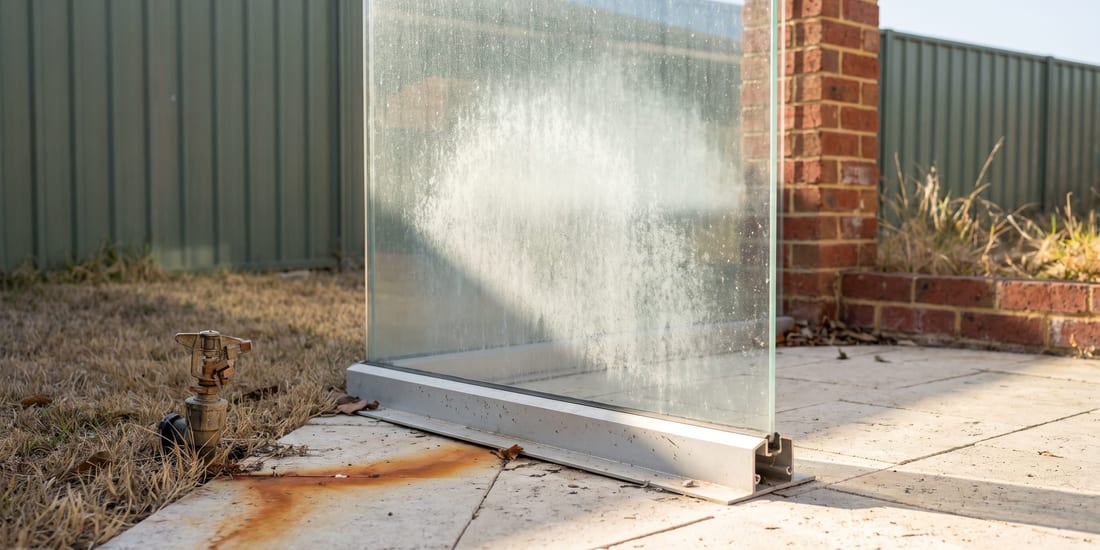
Repeat that over a summer and you do not have spots any more. You have a continuous, baked-on mineral film across the lower half of every panel facing the garden. Iron content adds a faint orange or brown cast that people often mistake for dirt in the glass itself.
Then add limestone dust. Perth sand and limestone fines blow constantly, and they are alkaline and mildly abrasive. That dust settles into the damp mineral layer and bonds with it. Near a pool, you can add splash-out carrying chlorinated water and the salt from saltwater chlorination systems, which dries into its own crust at the base of the glass.
None of this is dirt in the normal sense. It is a chemically bonded deposit, and that distinction is exactly why your cleaning routine is failing.
Why vinegar and supermarket glass cleaner smear instead of clean
Household glass cleaners are formulated for light soiling: dust, fingerprints, kitchen grease. They contain surfactants and solvents that lift loose grime so a cloth can carry it away. They are not designed to dissolve bonded calcium.
What happens when you use one on a mineral-filmed balustrade is predictable. The spray wets the deposit and softens the uppermost layer. Your cloth then drags that softened layer sideways. You have not removed the film, you have redistributed it into a thinner and more uniform coating. Under flat light it can look like a win. The moment the sun angles across the panel, every drag mark shows.
Vinegar is weak acetic acid and it does have some genuine effect on calcium, which is why the advice persists. The problem is dwell time and rinse. To meaningfully dissolve a bonded Perth mineral film, dilute vinegar would need to sit on vertical glass long enough to react, which it cannot do because it runs off. Then it needs rinsing with water that is itself free of minerals. If you rinse off vinegar with the garden hose fed by the same bore, you have just reapplied the problem. You also risk the acid sitting on stainless fixings and rubber gaskets, which does them no favours.
Toughened glass adds one more wrinkle. The toughening process can leave a very slight surface distortion known as roller wave, and some balustrade panels are specified with a textured or satin finish for privacy or grip. Any surface that is not optically flat gives mineral deposits more to hold onto and gives your cloth less chance of reaching into the low points. Film settles into the texture and stays there while the high points get polished, which is precisely the look people describe as "clean but still smeared".
What actually removes the film
Pure water cleaning works on a different principle, and it is worth understanding why rather than taking it on faith.
Water is a solvent. Ordinary tap or bore water is already carrying a load of dissolved minerals, so it has limited capacity to take on more. Run that same water through filtration, reverse osmosis and deionisation and you strip out essentially everything, leaving water that is chemically hungry. It actively pulls dissolved solids off any surface it touches and holds them in suspension.
Applied to a balustrade through a fed-pole brush, the sequence is: the brush agitates the surface and breaks the bond between the deposit and the glass, pure water lifts the loosened minerals into suspension, and a final rinse carries them off the panel entirely. The glass is then left to dry with nothing on it. No chamois, no squeegee, no cloth.
That last point is the whole difference. A squeegee is a redistribution tool. It is excellent at moving liquid, which is fine on genuinely clean glass, but on a filmed panel it pushes contamination to the edges and leaves the classic perimeter halo. Pure water removes the need to touch the glass at all after rinsing, so there is nothing to smear and nothing left behind to dry into streaks. It also reaches the back of pool fencing and the underside of balcony panels from the ground without ladders on uneven paving. If you want the full comparison, we have covered pure water versus traditional cleaning methods in more detail.
Stopping it coming back: nanocoating
Cleaning solves today. It does not change the fact that your retic will run again on Tuesday.
A glass nanocoating is a treatment applied after a full restorative clean that bonds to the glass at a microscopic level and fills the surface porosity. The result is a hydrophobic surface: water beads tightly and sheets off rather than clinging and evaporating in place. Fewer droplets sitting on the glass means fewer minerals deposited, and the deposits that do form sit on the coating rather than keying into the glass, so they release far more easily next time.
For balustrades near sprinklers, around pools, or on coastal frontages taking salt spray, this is the difference between a panel that hazes over within weeks and one that holds its clarity between cleans. It is not permanent and it is not a substitute for cleaning, but it dramatically reduces how fast the problem returns.
A quick check before you call anyone
Before assuming the worst, work out what you are actually looking at. Clean a small test patch on one panel properly, then dry it and inspect it in raking sunlight.
If the haze lifts and the patch goes clear, it is mineral film. Removable, and a candidate for coating afterwards.
If the marks remain and you can feel them with a fingernail from one side only, they are likely scratches, from grit dragged under a cloth or from abrasive pads. Scratches catch the nail. Film does not.
If the marks remain, feel perfectly smooth, and look like a cloudy stain within the glass rather than on it, that is probably etching. The minerals have corroded into the surface, which happens when hard water is left to bake on for a long period. That needs restorative polishing rather than cleaning.
If the panel was previously coated and now shows blotchy patches where water beads in some areas and sheets flat in others, the coating has worn unevenly and needs stripping and reapplying rather than more cleaning.
That one check tells you whether you have a cleaning job, a restoration job, or a recoating job, and it saves everyone time.
If your balustrade falls into the first category, which most do, the fix is not another spray bottle. It is deionised water, the right brush, and a rinse that leaves nothing behind. To get your balcony and pool glass properly stripped back and kept that way, talk to Purified Group’s Perth window cleaning team about a restorative clean and coating for your balustrades.
Frequently Asked Questions
Why does my glass balustrade look worse after I clean it?
Because household cleaners and vinegar soften mineral film without dissolving it fully, then your cloth drags the loosened residue across the panel. You end up with a thinner, more even layer of the same deposit, which catches the light as streaking.
Is bore water really the cause of spotting on my balustrade?
If your reticulation sprays anywhere near the glass, it is the most likely cause. Bore water carries dissolved minerals and often iron. When the droplets dry on glass in the sun, the water leaves and the minerals stay behind.
Can mineral film permanently damage glass balustrades?
Left long enough, yes. Minerals can etch into the glass surface, at which point cleaning no longer restores clarity and the panel needs restoration or replacement. Removing deposits before they bond is far cheaper than fixing etched glass.
Does nanocoating stop balustrade glass getting dirty?
It does not stop dirt landing, but it makes the surface far less willing to hold it. Water beads and runs off instead of sitting and evaporating, so fewer minerals are deposited and routine cleaning takes less effort.
How often should pool and balcony balustrades be cleaned in Perth?
It depends on exposure. Glass near active sprinklers, a pool or a coastal frontage generally needs attention more often than a sheltered internal stair balustrade. The tell is how quickly the haze returns after a proper clean.