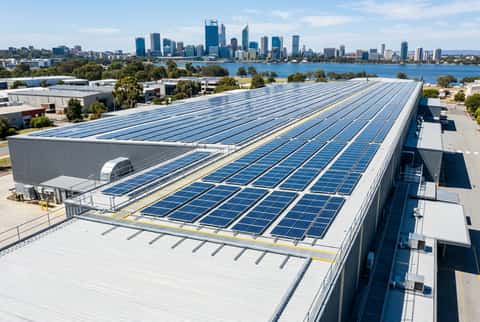
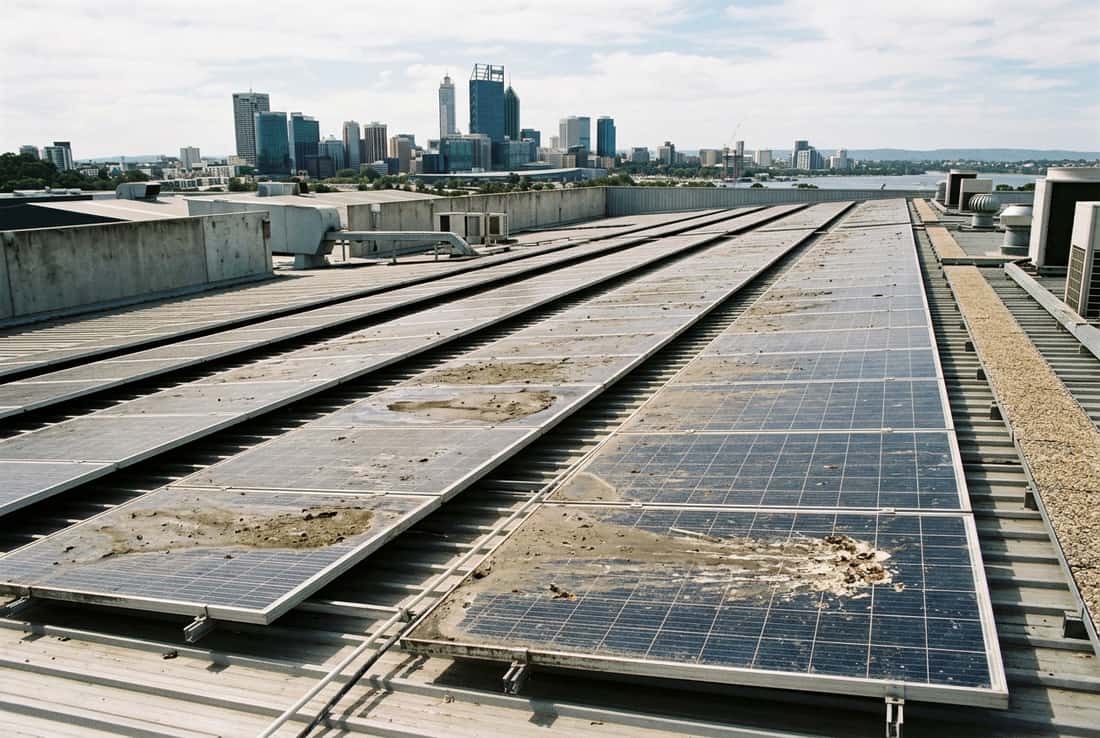
Commercial solar panels rarely go from clean to obviously filthy overnight. More often, the warning signs creep in gradually. A little more dust. A little more staining. A few obvious droppings that sit longer than they should. Because the roof is not always viewed up close, those signs are easy to ignore until the array starts looking visibly neglected from ground level.
For Perth businesses, spotting the early signs matters. It helps prevent the stop-start pattern where panels are ignored for too long and then cleaned only when someone finally notices how poor they look. A better approach is to know the common indicators that the array is overdue for attention, then arrange cleaning before build-up becomes the accepted normal condition of the roof.
The most obvious signs to look for
A dull or dusty surface across the array
One of the clearest signs is a flat, dusty finish across the glass. Even if there is no heavy grime in one area, a uniform dullness often shows that the array is carrying enough residue to need cleaning.
Patchy marks and bird droppings
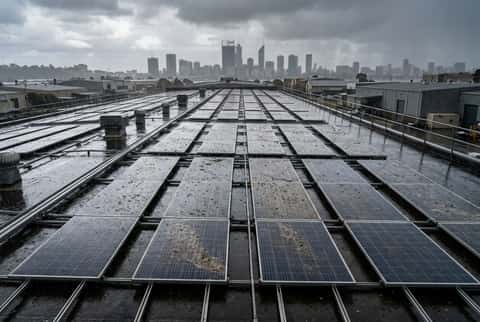
If sections of the roof have obvious marks, droppings, or streaking that remain for weeks, the panels are telling you they have gone too long without attention. Patchiness usually stands out more strongly on commercial systems because of the scale of the roof.
The array looks older than it should
Solar panels do not need to look brand new all the time, but they should not make a well-kept property look tired. If the roofline is starting to drag down the appearance of the site, that is a sign the cleaning schedule is too loose.
Rain is no longer improving the look
If the panels still look poor after a period of rain, that is another practical sign the roof needs proper cleaning rather than more waiting.
Less obvious signs businesses often miss
Sometimes the issue is not dramatic dirt but a pattern of small clues. The roof may look acceptable on one side and poor on another. Some rows may hold spotting after rain while others do not. Staff may notice the panels look messy from upper-floor windows or from the car park at a certain angle in the afternoon light.
Another common sign is when panels are being discussed internally because they have become noticeable. Once the condition of the array has reached that point, the roof has usually been overdue for a while.
On commercial sites, the standard should not be based on the roof looking as bad as possible before anyone acts. The better standard is to clean it before the build-up becomes part of the normal appearance of the premises.
Site managers also sometimes notice that the panels are the only part of the property not being maintained to the same standard as glazing, entries, or surrounding surfaces. That mismatch is a warning sign in itself.
Why early action is better than catch-up cleaning
Cleaner sites are easier to maintain
A site that is kept on top of is simpler to manage than one that falls into periodic catch-up mode. Early cleaning helps avoid the visual decline that makes the roof look neglected.
Businesses can schedule around operations
When the signs are recognised early, cleaning can be fitted around quieter periods, access windows, and site routines. That is far easier than reacting late because the array has become an obvious eyesore.
The roof stays aligned with the rest of the property
Most businesses would not allow customer-facing glass, entry areas, or key external surfaces to remain visibly grubby for months. The same logic should apply to solar panels, especially on larger buildings where the roof makes up a significant part of the property footprint.
The decision becomes easier
Acting early usually means cleaning is seen as normal maintenance rather than an emergency response. That keeps internal decision-making simpler and more consistent.
What businesses in Perth should do next
Purified Group’s live site presents solar panel cleaning as part of broader ongoing exterior maintenance across Perth and supports that with separate commercial location pages. That means commercial sites do not need to wait until conditions are severe before acting. If the array is already looking flat, marked, patchy, or overdue, it makes sense to treat that as the signal to organise a proper clean and then work out a better repeat schedule from there.
The earlier those signs are picked up, the easier it is to keep the roof in step with the rest of the business. A practical clean now often prevents a larger visual decline later. That is why recognising the signs matters.
Do not wait until the panels become the part everyone notices
If the roof already looks dull, patchy, or older than it should, the signs are there. A timely clean usually solves the immediate issue and makes it easier to plan a smarter maintenance cycle afterwards.
See Commercial Solar Panel Cleaning for broader service details or visit the Purified Group homepage. For local commercial service pages, start with Welshpool or Bibra Lake.
Why this matters more on commercial sites than small homes
Commercial roofs often cover a much larger footprint than residential systems, so the visual effect of neglect is bigger once it starts to show. A few dirty panels on a home can be easy to miss. A broad dusty array on a warehouse or office roof changes the look of the whole building.
Commercial properties also tend to have more people interacting with the site. Staff, visitors, tenants, suppliers, and clients may all see the building from different positions. That means the roof condition matters more than it does on a private home where very few people ever look at it.
Because of that, catching the signs early is not just about cleanliness. It is about keeping the overall site standard where it should be and avoiding the point where the roof begins to look obviously forgotten.
Frequently Asked Questions
What's the clearest sign a commercial array needs cleaning?
A drop in generation reported by your monitoring system is usually the most reliable signal, since visible haze can be hard to judge accurately from ground level on a large roof.
Should I wait until panels look visibly dirty?
No. By the time industrial fouling is visible from the ground, output has typically already dropped meaningfully, so a scheduled interval is more cost-effective than waiting for visible signs.
Who should I contact if I notice reduced generation?
Call Purified Group for a site assessment. We inspect the array, confirm whether fouling is the cause, and provide a written quote before any work begins.