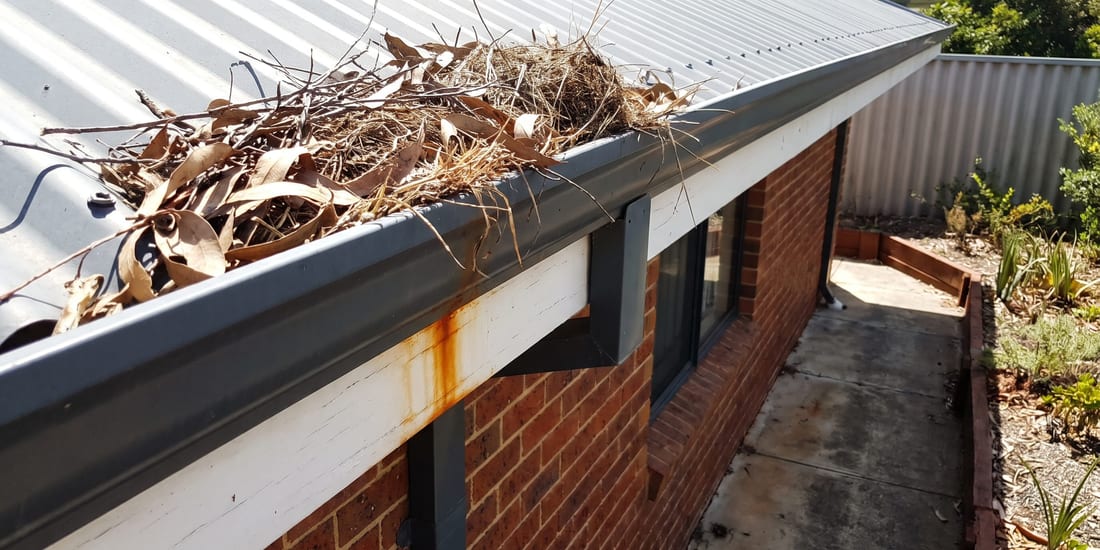
A gutter is, from a bird’s point of view, an excellent place to raise a family. It sits above ground level and away from cats, it is sheltered by the roof edge, and in a Perth suburb with established trees it already comes pre-stocked with twigs, dry grass and leaf litter. The fact that it is also the part of your house responsible for moving several hundred litres of water away from your foundations during a winter front is not a bird’s problem. It is yours.
Finding birds nesting in a gutter tends to happen in one of two ways. Either you notice the traffic yourself, a pair of birds doing laps to the same corner of the roof, or a gutter cleaner finds it partway through a job and comes down the ladder to talk to you about it. Both situations call for the same first step, which is not removal. It is working out whether anything is living in there.
Why Perth gutters attract nesting birds in the first place
A few things about Perth housing stock make gutters unusually inviting.
Tile roofs are common across the older suburbs, and the gap between the bottom course of tiles and the gutter is a ready-made covered entrance. Steel sheet roofs tend to be tighter, but they bring their own cavities around valleys, barge capping and solar panel mounts. Panels in particular create a shaded, sheltered void that birds will use if the gap underneath is open at the edges.
Then there is the vegetation. Jacarandas, peppermints, gums and Norfolk Island pines all shed steadily, and in the streets where those canopies overhang the roofline the gutter does not need much help to become a nesting substrate. A gutter that has gone a year or two without a clean already contains a compacted mat of leaf litter. A bird does not have to build much on top of that.
Timing matters too. Most local species nest through late winter and spring, which puts the peak of nest building several months before Perth’s wettest, windiest weather and several months after the worst of summer. That gap is useful, and we will come back to it, because it means a well-timed gutter clean often lands when nests are empty rather than occupied.
The birds involved are usually a mix of natives and introduced species. Doves and feral pigeons are frequent gutter and eave users around Perth, and welcome swallows build mud nests tucked under eaves and gutter returns.
Active or abandoned: how to tell before anyone touches it
This is the distinction everything else hangs on, and it is usually possible to make it from the ground without climbing anything.
Spend fifteen or twenty minutes watching the spot, ideally in the morning and again in the late afternoon. Signs that a nest is active include:
- Adult birds arriving and leaving repeatedly at the same point on the roofline, often with material or food in their beaks
- Audible calling from chicks, which is easiest to hear in the early morning
- Fresh, wet droppings on the wall, driveway or paving directly below the nest site
- A nest that holds its shape, with a clear cup and clean-looking material
Signs that a nest has been abandoned are usually just as clear once you know what to look for. Old nests flatten and weather. The material goes grey, the cup collapses, and leaf litter and dust settle over the top of it. Droppings below will be dry, old and bleached rather than fresh. Most tellingly, nothing comes and goes.
Two cautions. First, do not assume an empty-looking nest is finished with. Some species reuse nests across seasons, and a sitting bird can be very still and very quiet when something the size of a person is on the roof. Second, do not poke a nest to find out. That turns an observation into an interference, and it is also how people end up with mites on their hands.
If you genuinely cannot tell, that is a reasonable thing to say to your gutter cleaner. It is a better outcome than guessing.
What WA wildlife protection means for you
Native birds in Western Australia are protected fauna. Protection extends to the birds themselves, and disturbing an active nest with eggs or dependent young is not something a homeowner should take into their own hands. The Department of Biodiversity, Conservation and Attractions (DBCA) is the relevant authority, and the Wildcare Helpline is the usual starting point for advice on injured or displaced native wildlife.
Introduced species sit in a different category under the rules. The problem is that identifying a species from forty centimetres of twigs in a gutter is not straightforward, which is a good argument for treating every unknown nest as protected until you know otherwise.
None of this is legal advice or a substitute for asking the right body. If you are facing a nest that is genuinely blocking a critical downpipe ahead of a storm warning, the sensible move is to ring DBCA and ask rather than to make a judgement call on a ladder.
What a gutter cleaner actually does when a nest turns up mid-job
Here is how this should play out on the day.
The cleaner is working along a run of gutter and encounters nesting material. Work in that section stops. Clearing around a nest with a blower or by hand is still disturbance, and blowing debris past an occupied nest can bury or flush it just as effectively as removing it.
Next comes an assessment from the roof, which is genuinely useful because it reveals things you cannot see from the lawn: whether there are eggs, whether the cup is lined and intact, whether droppings inside the gutter are fresh. The cleaner should come down and tell you what is there rather than making the decision for you.
From that point there are three realistic paths.
Proceed. The nest is clearly old and abandoned. It is removed as part of the normal clear-out, along with the leaf litter it is sitting in.
Clean around and reschedule. The nest is active. The rest of the roof and the other gutter runs get cleaned properly, that section is left alone, and a return visit is booked for after the young have fledged. For most species this is a matter of weeks, not months.
Refer. There is a genuine conflict, such as an active nest sitting directly in a box gutter or over the only downpipe on a critical run with weather coming. That is the point to involve DBCA rather than improvise.
A cleaner who shrugs and clears it regardless is doing you no favours, and a cleaner who abandons the entire job over one nest in one corner is not doing you many either.
The real hazard profile, and it is not just blocked water
Nests cause three distinct problems, and they peak at different times of year.
Blockage before storm season. This is the obvious one. A nest in the gutter line or, worse, packed into a downpipe outlet turns a functioning drainage system into a dam. Perth winter fronts can deliver a lot of water in a short burst, and overflowing gutters push water back under the roof edge, into eaves and down external walls. The damage shows up as stained ceilings and soggy fascia boards long after the storm has passed.
Fire risk in summer. Nesting material is dry twigs, grass and feathers sitting in a metal channel at roof height. For homes on Perth’s bushland fringe, that is ember fuel in exactly the place ember attack starts. Clearing gutters before bushfire season is standard advice for good reason, and old nests are part of what needs to come out.
Mites and parasites. This one catches people out. Bird mites live in nests and feed on the occupants. When a nest is abandoned and the birds leave, the mites do not simply die on the spot. They disperse looking for a new host, and in a roof cavity or under eaves that search can lead them indoors through weep holes, vents and gaps around light fittings. Perth’s warm, dry conditions do nothing to discourage them. It is a reason to wear gloves, a reason not to handle nesting material casually, and a reason not to leave an abandoned nest in place indefinitely on the assumption it is harmless.
Fold nest checks into the pre-storm clean, not a separate panic
The most practical thing to take from all of this is a timing point.
Because most local nesting happens through late winter and spring, a gutter clean scheduled for autumn, before the first serious fronts arrive, usually finds nests that are already empty. You get to remove them cleanly, you clear the leaf litter they were built on, and you go into winter with the water actually going where it should. That is a far better position than discovering a blockage during a downpour.
That seasonal logic is the same reason autumn gutter work matters generally, and it is covered in more detail in our guide to gutter cleaning before Perth’s storm season.
Treat the nest check as part of that annual job rather than a separate emergency. Ask whoever cleans your gutters to tell you what they find, including old nests, and to note where the birds are getting in. Repeated nesting in the same corner usually points to a specific gap, a lifted tile, an open gutter return, a missing section of eave mesh, that is worth closing once rather than clearing every spring.
If you would rather have someone assess what is up there before the weather turns, Purified Group’s Perth gutter cleaning service covers a full clear-out with a look at nesting points and entry gaps while the ladder is already up.
Frequently Asked Questions
Is it illegal to remove a bird’s nest from my gutter in WA?
Native birds and their nests are protected under Western Australian biodiversity law, which is administered by the Department of Biodiversity, Conservation and Attractions. An abandoned nest is generally treated differently from an active one with eggs or chicks. If you are unsure, contact DBCA or the Wildcare Helpline before anything is disturbed. This article is general information, not legal advice.
How can I tell if a nest in my gutter is still being used?
Watch it from the ground for fifteen to twenty minutes at a few different times of day. Birds flying in and out, calling from chicks, fresh droppings below the nest and intact nest structure all suggest it is active. Flattened, weathered material with no bird traffic and no fresh droppings usually means it has been abandoned.
When is bird nesting season in Perth?
Most local species nest through late winter and spring, which means nests built during that period are often empty by the time autumn pre-storm gutter cleaning comes around. That timing is one reason autumn is a sensible window for a thorough clear-out.
Can an old nest in my gutter be a fire risk?
Yes. Nesting material is usually dry twigs, grass and leaf litter, exactly the fuel that catches embers. Combined with the leaf load that builds in a gutter over summer, it is a real concern for homes on Perth’s bushland fringe.
What happens if a gutter cleaner finds an active nest during the job?
A professional should stop work in that section, assess whether the nest is active, and discuss options with you rather than clearing it. In most cases the rest of the roof is cleaned and that section is rescheduled once the birds have fledged.