It is one of the most common questions we hear about driveways in this city. The aggregate has gone grey and blotchy, there is black spot creeping along the shaded edge, and a bottle of household bleach costs less than a takeaway coffee. Pour it on, hose it off, problem solved.
Except it usually is not. Cleaning exposed aggregate with bleach is a short-term cosmetic fix that frequently costs more than it saves, particularly in Perth, where intense UV and salt-laden air are already working against your driveway. Below is what actually happens at the surface, why the results fade faster than people expect, and what to use instead.
Exposed aggregate is not flat concrete, and bleach treats it differently
On a trowelled concrete slab, bleach sits in a thin film on a closed surface. You apply it, it does its work on surface organics, and the rinse carries most of it away. The surface is uniform, so the result is uniform.
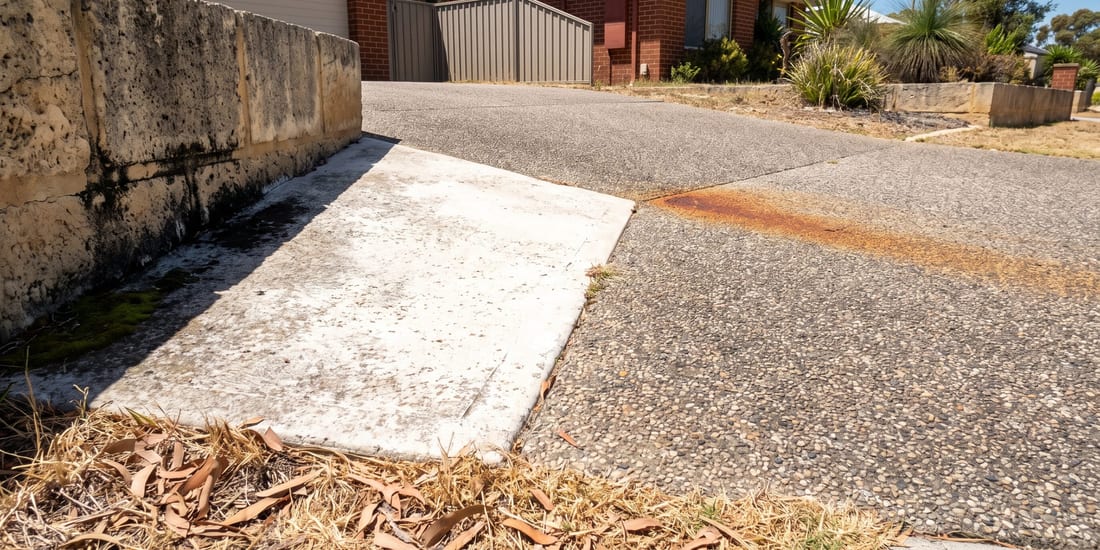
Exposed aggregate is a different geometry entirely. The top layer of cement paste has been washed away during construction to reveal the stones beneath, which leaves thousands of small recesses between the pebbles. Those recesses are where bleach collects and stays.
Three things follow from that.
The solution does not drain evenly. Liquid pools in the low points and runs off the high points. You get stronger exposure in the gaps and weaker exposure on the stone crowns, which is exactly backwards from what you want. The result is a driveway that looks cleaner from a distance and distinctly mottled up close.
The binder is more exposed than it looks. The stones in exposed aggregate are usually inert river pebbles or crushed granite, and chlorine does very little to them. The cement paste holding them in place is another matter. Sodium hypochlorite is strongly alkaline and reactive, and repeated applications can soften and weaken that matrix over time. On a surface where the binder is already the structural weak point, that matters. Loose stones and a gritty, shedding surface are the long-term symptom.
Rinsing is harder than it looks. A garden hose moves water across the high points. It does not reliably flush residue out of every recess. Whatever is left behind keeps reacting, keeps drawing moisture, and keeps working on the sealer long after you have put the bottle away.
What Perth’s climate does to a bleached surface
This is where the local conditions turn a mediocre idea into a genuinely expensive one.
Most sealed exposed aggregate in Perth carries an acrylic or penetrating sealer. Acrylics in particular are already under constant assault from UV. Our summer sun delivers high UV levels for months on end, and that steadily breaks down the polymer chains in the coating, which is why unprotected sealers chalk, haze and wear thin over the years rather than lasting indefinitely.
Chlorine bleach accelerates that process. It oxidises the sealer film from above, dulling the finish and opening up micro-defects. UV then gets into those defects far more easily than it would into an intact film. You have effectively given the sun a head start.
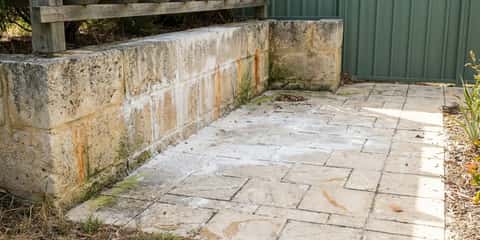
Add coastal air. A large share of Perth’s suburbs sit close enough to the ocean for salt-bearing wind to be a daily reality, and inland properties get their share through the sea breeze. Salt is hygroscopic, meaning it holds moisture against the surface, and once a sealer has been compromised that moisture has somewhere to go. Residual chlorides from the bleach itself add to the salt load. In homes with exposed steel elements near the driveway, such as gate posts, balustrade fixings or fence bases, chloride residue is an additional corrosion risk that is worth taking seriously.
Then there is the rebound. This is the part most people only notice on the second or third round. Mould, lichen and black spot are living organisms with root structures that penetrate below the visible surface. Bleach bleaches. It strips the pigment out of the organism so the stain disappears, but it often fails to kill the biology underneath. Meanwhile the surface you have just treated is more porous than it was, because the sealer has lost integrity. A more open surface holds more moisture and more airborne dust, which is precisely what regrowth needs. The stain comes back, and it comes back sooner each time.
Safer alternatives, and when each one makes sense
There is a genuine place for DIY maintenance between professional cleans. The product choice is what matters.
pH-neutral concrete cleaner is the default for general grime. Dust film, light tyre marks, bin residue, the ordinary dulling that builds up over a few months. A neutral cleaner lifts soil without attacking the sealer, and it is safe on nanocoated surfaces. Apply, agitate with a stiff broom, rinse thoroughly. This is the product that should live in your shed.
Oxygen bleach, properly called sodium percarbonate, is the right tool for organic staining. It releases hydrogen peroxide in water, which breaks down organic matter and then decomposes into water, oxygen and soda ash. No chlorides, no strong alkaline residue, far less risk to sealers and surrounding plants. It needs dwell time rather than brute strength, so mix it, keep the surface damp while it works, and give it longer than you think. It is slower than chlorine and considerably less destructive.
Chlorine bleach has a narrow legitimate use case: unsealed, uncoated concrete with no warranty attached, used sparingly, rinsed hard. On sealed or nanocoated exposed aggregate, there is almost no scenario where it is the best choice available.
Acid-based products deserve a specific warning. Hydrochloric acid washes sold for brick cleaning will etch the cement matrix of exposed aggregate quickly and permanently. Keep them away from the driveway.
Warranties and coatings: the detail that catches people out
If your driveway has been professionally sealed or nanocoated, read the documentation before you clean it with anything.
Sealer and coating warranties almost universally specify a maintenance regime, including which products are approved. Chlorine bleach appears on the excluded list far more often than not. Nanocoatings in particular work by forming an extremely thin, chemically bonded layer that changes how water and contaminants interact with the substrate. That bond is durable against UV, traffic and weather. It is not designed to be a sacrificial barrier against repeated strong oxidisers.
The practical consequence is simple. If a coating fails prematurely and there is evidence of bleach use, the applicator has reasonable grounds to decline the claim. You end up paying for a full recoat that the warranty would otherwise have covered. Saving a service call fee to lose a coating warranty is a poor trade.
Cost and time: the DIY cycle compared honestly
The appeal of bleach is the price of the bottle. The real comparison is the cycle, not the bottle.
A DIY bleach treatment means buying product, moving cars and pot plants, protecting or accepting damage to adjacent garden beds, applying, waiting, scrubbing, rinsing at length, and doing it again when the stain returns. That is most of a weekend morning, and because the biology was never killed and the surface is now more porous, the interval before the next round shortens each time. Three or four cycles a year is common for people on this path, along with a surface that is visibly degrading.
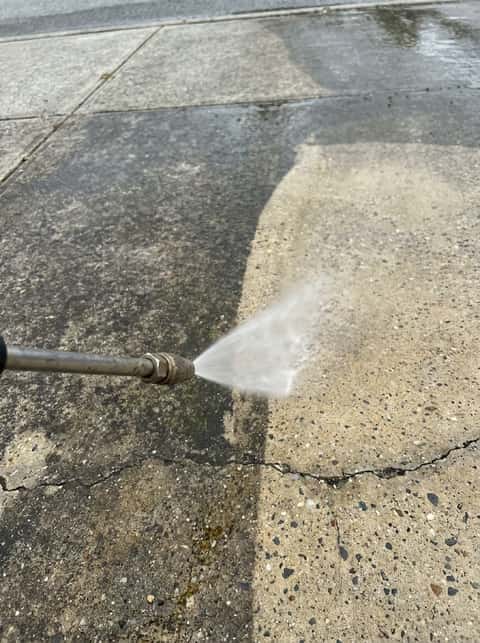
A professional clean is a single booking. Hot water or surface cleaner attachments deliver even coverage across the aggregate rather than pooling in the recesses, appropriate biocides target the organism rather than just the pigment, and the surface is left ready for sealing or coating if that is the next step. The interval afterwards is measured in many months, not weeks. Our guide on how often you should pressure clean your driveway in Perth covers realistic timing for different suburbs and exposures.
Over a few years, the cumulative hours plus product plus eventual resealing of a prematurely failed surface tends to exceed what regular professional maintenance would have cost. The bleach route rarely saves money. It defers the cost and adds damage to it.
When to stop and call someone
Some clear signals that DIY has gone as far as it usefully can:
- The stain returns within weeks of treatment, or returns worse than before.
- You can see mottling, patchiness or a dull, chalky film where the surface used to look even.
- Stones are loosening, or you are sweeping up grit that was not there last year.
- Water no longer beads on a surface that used to be sealed or coated.
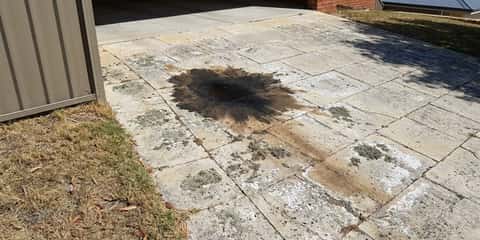
- The staining is oil, rust or tannin from overhanging trees rather than general grime.
- Your driveway is under warranty and you are not certain which products are approved.
Any of those means the issue is now in the substrate or the sealer, and more chemical will make it worse rather than better. At that point the correct sequence is a controlled professional clean, an honest assessment of whether the existing sealer is salvageable, and a decision about whether a nanocoating is worth it for your exposure. In coastal suburbs and shaded blocks, it usually is, because it tackles the cause rather than the symptom.
If your exposed aggregate has reached that stage, or you want it cleaned properly before deciding on a coating, have a look at Purified Group’s Perth pressure cleaning and book an assessment of the surface before the next bottle goes on it.
Frequently Asked Questions
Does bleach damage exposed aggregate?
Chlorine bleach rarely etches the stone itself, but it can attack the cement matrix holding the stones in place and degrade acrylic or penetrating sealers. On exposed aggregate the solution also pools in the gaps between stones, so the damage is uneven and shows up as patchiness later.
What is the safest thing to clean exposed aggregate with?
A pH-neutral concrete cleaner handles general grime without touching the sealer. For organic staining such as mould, lichen and black spot, an oxygen bleach (sodium percarbonate) solution is far gentler than chlorine and rinses away without leaving a reactive residue.
Will bleach void my driveway sealer or nanocoating warranty?
Often, yes. Most sealer and coating warranties specify approved cleaning products, and chlorine bleach is usually excluded. Using it can give the applicator grounds to decline a claim, so check your product documentation before reaching for a bottle.
Why do stains come back faster after I bleach my driveway?
Bleach lightens the stain but leaves the surface more porous once the sealer has been compromised. A more open surface absorbs moisture, dust and spores more readily, so regrowth and soiling return sooner than before.
How often should exposed aggregate be professionally cleaned in Perth?
Most Perth driveways benefit from a professional clean roughly once a year, with coastal and heavily shaded properties often needing it more frequently. Sealing or nanocoating afterwards extends the interval considerably.