White vinegar has a reputation online as the universal green cleaner. It is cheap, it is already in most kitchens, and for some jobs it genuinely works. That reputation is why so many Perth homeowners reach for it when the rendered front wall starts looking grubby, streaked or spotted.
The problem is that render is not paving, and it is not a glass shower screen either. It is a thin, porous, sometimes pigmented coating sitting over brick or block, and its chemistry matters. Cleaning render with white vinegar can work on a narrow set of problems and can visibly wreck the finish on others. The difference comes down to what your render is made of, whether it is painted, and what the marks actually are.
Why render is not paving
Vinegar is a dilute acid, usually around five percent acetic acid at household strength. On paving, acid can be useful because it attacks mineral deposits, and the substrate underneath is thick, dense and replaceable in sections.
Render is none of those things. It is a sacrificial layer, often only a few millimetres thick, and the three common types in Perth react to acid in three different ways.
Cement-based render is alkaline. Acid and alkali react, and that reaction is not a cleaning action, it is a chemical attack on the binder holding the sand together. Mild exposure can leave the surface slightly chalky or raise a fine dust when rubbed. Repeated or stronger exposure can open the surface up, making it more absorbent and more likely to attract dirt and organic growth in future. In other words, an aggressive vinegar clean can make the wall dirtier faster next time.
Acrylic-textured render behaves differently again. The binder here is a polymer rather than cement, so the acid is less likely to eat the surface outright. The risk shifts to the finish. Acrylic renders rely on a consistent texture and a consistent sheen, and acid plus scrubbing plus uneven rinsing can leave areas that look flatter or glossier than their surroundings. Because acrylic render often carries its colour through the product rather than in a separate paint coat, any surface change shows up directly as a colour change.
Limestone-based render is the most vulnerable of the three, and it is not rare in Perth given how much limestone is used locally. Limestone is calcium carbonate, and acid dissolves calcium carbonate. That is not a theory, it is the basic reaction. Vinegar on a limestone-based render can etch a visible dull patch into the surface quickly, and etching is not something you clean off afterwards. The material is gone.
The specific risk on painted and pigmented render
Most advice about vinegar on render stops at "it can leave residue behind". That badly understates the issue on a coated or pigmented wall, where three distinct things can go wrong.
Etching. On any render with a lime or cement component, acid micro-roughens the surface. Light hits a roughened surface differently, so the treated area reads as a dull patch even after it is completely dry and clean. On a long wall with repeated applications, that becomes a visible band.
Dulling of the sheen. Exterior paints and pigmented acrylic renders are specified at a particular sheen level, from flat through to low sheen. Acid combined with scrubbing can shift that sheen locally. The dirt is gone, but now there is a patch that catches the light differently from every angle, which is often more noticeable than the original grime was.
Colour patchiness. Pigments vary in how well they tolerate acid, and the binder holding them is part of the equation too. A diluted vinegar wash can lift a very thin layer of pigmented surface, leaving an area a shade lighter. Because it happens gradually as you work across the wall, you often do not notice until it dries and you step back.
None of these are fixable with more cleaning. They are fixed with a repaint or a re-render, which is a different budget entirely.
How Perth’s hard bore water makes it worse
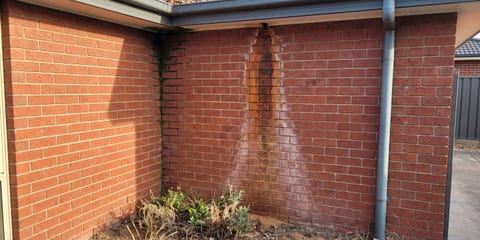
Plenty of Perth homes rinse down with bore water, either through a reticulation outlet or from a garden tap fed by the bore. Perth groundwater is typically hard and often carries a significant iron load, which is why so many front fences and lower render courses in bore-irrigated suburbs carry orange staining.
That water chemistry works against you twice when vinegar is involved.
First, hard water contains dissolved calcium and magnesium. Vinegar reacts with those minerals as readily as it reacts with the dirt, so some of the acid is spent on the rinse water itself. The clean is weaker than expected, which tempts people into using more vinegar or less dilution.
Second, and more visibly, hard water leaves mineral deposits behind as it evaporates. If you rinse a vinegar-treated wall with bore water on a hot day, you are laying fresh mineral salts onto a surface that has just been chemically opened up and made more absorbent. The result is the pale, chalky, streaky look that homeowners often mistake for leftover vinegar. It is not the vinegar you are seeing, it is what the rinse water left behind.
A render-specific test patch method
Many homeowners genuinely do not know which type of render they have, particularly if the house was rendered by a previous owner or overpainted since. That alone is a reason to test properly, and a test patch on render is not the same as one on tile, because the damage is often subtle and slow to appear.
- Choose a genuinely hidden area. Behind a downpipe, low on a side wall near the fence line, or inside a recess. Avoid anywhere at eye level or in view from the street.
- Dilute first. Start at roughly one part household white vinegar to ten parts water. If the wall responds well, you can step it up later. Starting at full strength removes your ability to learn anything useful.
- Wet the wall first. A pre-wet surface absorbs less of the solution, which limits how deep any reaction goes.
- Apply with a soft brush or sponge, not a stiff broom. Give it no more than a minute or two of dwell time.
- Rinse thoroughly with scheme water if you have it. This is the step people skip, and it is the one that causes most of the streaking.
- Wait at least 48 hours and check in different light. Early morning and late afternoon raking light will show etching, sheen changes and colour shifts that midday sun hides completely. Run a dry hand over the patch. If you pick up chalky dust that was not there before, stop.
If anything about the patch looks different from the surrounding wall after two days, you have your answer.
When vinegar is fine, and when the marks mean something else
Vinegar has a narrow legitimate window on render. Light surface dust, general atmospheric grime, a few splash marks, the kind of soiling that would mostly come off with water and a soft brush anyway. In those cases a weak vinegar solution is a marginal improvement over plain water, and the risk is low if the render is sound and you rinse well.
The window closes as soon as the marks have a cause.
Green, grey or black growth is mould, algae or lichen. It is a living organism with roots into the porous surface, common on shaded southern walls, under eaves, near garden beds and anywhere irrigation overspray keeps the render damp. Vinegar may bleach the visible surface so it looks clean for a few weeks, but it does not reliably kill what is below. The growth returns, often faster, because the surface has been opened up.
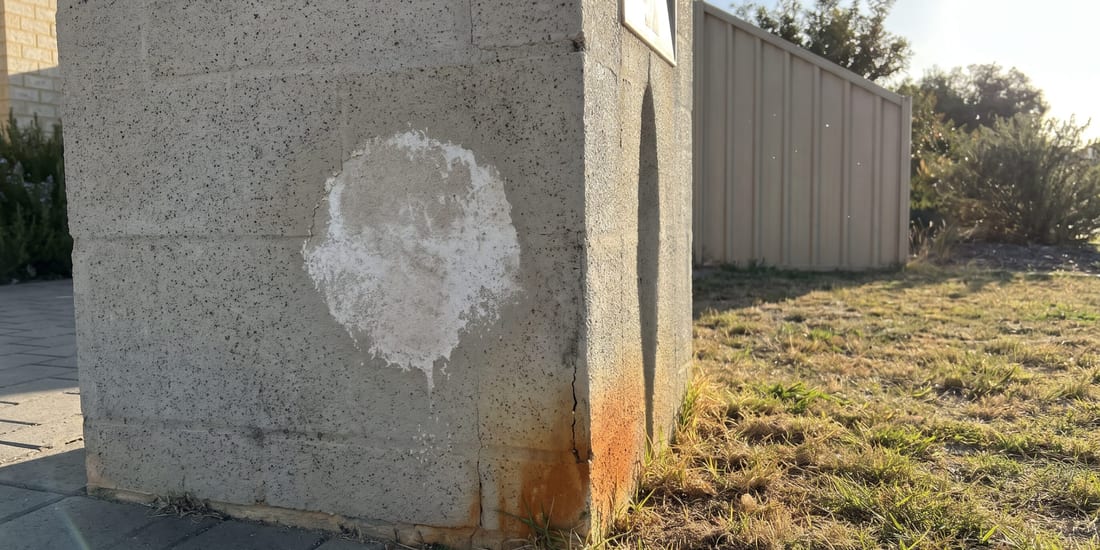
White powdery bloom is usually efflorescence, salts migrating out of the masonry and crystallising on the face as moisture evaporates. The marks are a symptom of water moving through the wall. Acid can appear to remove it, and it will come straight back while the moisture source remains. Efflorescence is a signal to investigate drainage, reticulation spray, leaking gutters or flashing, not just a cleaning job.
In both cases, vinegar treats a visual symptom while the actual cause continues.
Where DIY stops
If the wall is lightly dusty, the render is sound, and you have scheme water for rinsing, a careful clean with water and a soft brush is a fair weekend job. Vinegar at low dilution sits right at the edge of that.
Call for help when any of these apply: you do not know what type of render you have, the render is painted or pigmented and you cannot risk a patch, there is established mould or algae rather than surface dust, there is efflorescence or any other sign of a moisture problem, or the wall is two storeys and you would be working off a ladder with wet chemicals.
Professional render cleaning is done as a soft wash: low-pressure application of a solution matched to the render type, controlled dwell time, and an even rinse. The cleaning is done by the chemistry, not by water pressure, which is why high-pressure washing is the other common cause of render damage in Perth. Pressure blows texture off acrylic finishes, drives water behind the render at joints, and strips paint in bands you then have to repaint. A soft wash is a cleaning service, not a coating or sealing service, and no one should be telling you a wash will waterproof your render.
If you are weighing up whether to tackle the whole house yourself, it helps to understand what the job involves across different surfaces and how that shapes quoting. Our guide to how much exterior house cleaning costs breaks down the variables, including why render is usually priced differently from paving and roofing.
Render is one of the least forgiving surfaces on a Perth home, and the mistakes show from the street. If you are unsure about a wall, or you have already tried vinegar and ended up with patches you cannot even out, get an assessment before the next attempt makes it harder to fix. You can talk through your render with Purified Group’s Perth pressure cleaning team and find out whether a soft wash is the right call.
Frequently Asked Questions
Will white vinegar damage rendered walls?
It can. Vinegar is acidic, and cement-based and limestone-based renders are alkaline, so the acid reacts with the surface rather than just lifting dirt. On painted or pigmented render it can also dull the sheen and leave patchy, lighter areas. Light dilution and a test patch reduce the risk, but vinegar is never a guaranteed safe option on render.
What is the safest thing to clean render with?
For general grime, clean water and a soft brush with a mild pH-neutral detergent is the lowest-risk starting point. Anything beyond that, especially mould, algae or efflorescence, is better handled with a low-pressure soft wash using products chosen for the specific render type.
Why does my render look streaky after I cleaned it with vinegar?
Streaking usually means the vinegar reacted unevenly with the surface, or that residue was left behind and then dried in runs. In Perth, hard bore water used for rinsing can make this worse by depositing minerals as it evaporates, leaving pale tracks down the wall.
Can I use a pressure washer on rendered walls instead?
High pressure on render is a common cause of damage, including blown texture, lifted paint and water driven behind the render. Render should be cleaned with low-pressure soft washing, where the cleaning is done by the solution rather than the force of the water.
How do I know if the marks on my render are mould or efflorescence?
Mould and algae are usually green, grey or black, often on shaded walls and worse near garden beds and downpipes. Efflorescence is a white or off-white powdery bloom that comes from salts migrating out of the wall. They need completely different treatments, which is why identifying the cause matters before you clean.