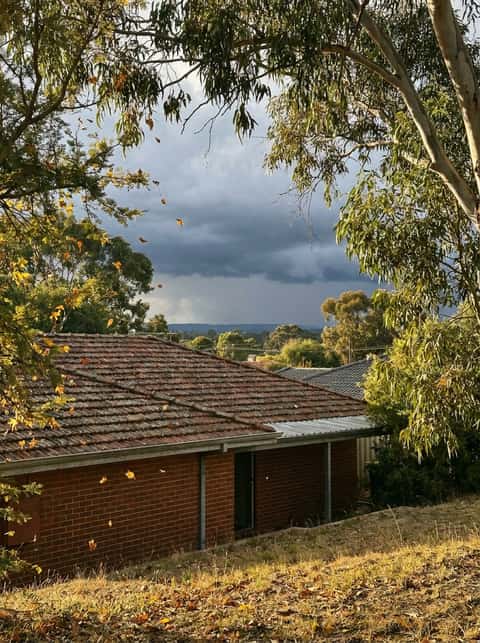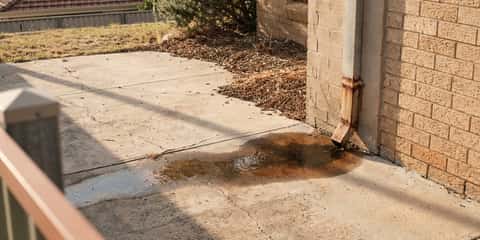
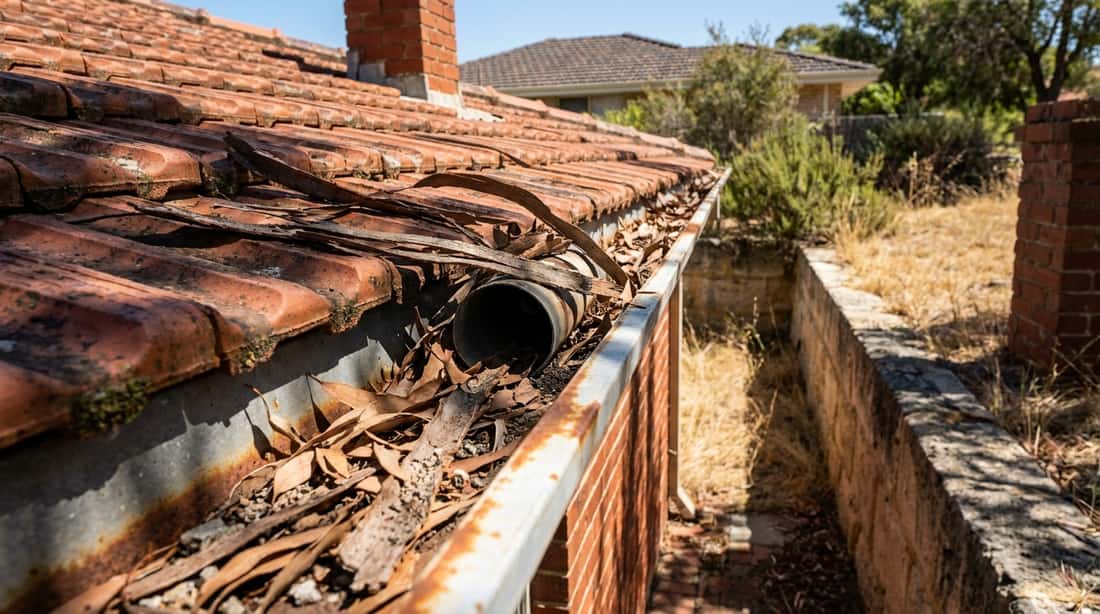
Most advice about gutter cleaning frequency was written for somewhere else. It assumes deciduous trees, a long autumn leaf fall and rain spread evenly across the year. Perth does none of those things. Our rain arrives in concentrated winter fronts, our trees drop debris in a pattern set by flowering and heat rather than a tidy autumn, and a huge proportion of our housing stock is concrete or terracotta tile.
Tiles change the job. They change how debris moves, where it collects, and how safely the work can be done. So the honest answer to how often you should clean the gutters on a tile roof in Perth is not a single number, but it is close to one, with a few clear reasons to shift it.
The short answer, then the reasons
For a Perth tile roof with little to no overhanging vegetation, once a year is generally enough, timed to land before winter.
For a tile roof with mature trees nearby, particularly gums, pines, palms or jacarandas, twice a year is realistic. Once in late autumn to clear the year's accumulation before the rain, and once in late spring or early summer to clear flowering debris, seed pods and the fine grit that builds up through the dry months.
For a home surrounded on more than one side by heavy canopy, or with a complex roof carrying several valleys, three visits a year is not unreasonable. The gutters may look passable, but the valleys will not be.
Why tile profiles hold debris differently
A tiled roof is not a smooth plane. Every tile has a ridge and a trough, and each course overlaps the one below. Leaves, gum nuts, bark strips and blossom that land on the roof do not simply slide off in the first shower. They lodge in the troughs and against the tile laps, then release gradually over weeks, often in a rush during the first heavy downpour.
This has two consequences. The first is that a gutter can look reasonably clear in February and be substantially blocked after one strong front in June, because the roof itself was holding a reserve of debris that all arrived at once. The second is that surface moss and lichen, which Perth tile roofs pick up readily on shaded southern faces, break down into a gritty sludge that washes into the gutter and sets hard. That sludge is heavier and more stubborn than loose leaf litter, and it is a common reason gutters on older tile roofs need more attention than the tree cover alone would suggest.
Valleys are the real pressure point
On a hipped tile roof, the valleys do the heavy lifting. Two roof planes meet and funnel their combined catchment into a metal channel roughly the width of a hand. Anything the roof sheds arrives there first.
Valleys block from the top down. Debris catches on the valley tiles, builds into a dam, and then water backs up and travels sideways under the tiles instead of running down the channel. Because the leak appears inside the ceiling rather than over the gutter edge, homeowners often do not connect it to gutter maintenance at all.
This is the single biggest reason tile roofs deserve a different frequency conversation than metal roofs. You can have clean gutters and a valley that is 80 per cent choked. Any inspection worth paying for should include the valleys, not just the gutter line, and on a roof with several valleys under trees, that alone can justify a second visit each year.
Perth trees and what they actually drop
The frequency you need depends less on how many trees you have and more on which ones.
Eucalypts are the main offender. They shed leaves, bark, twigs and gum nuts more or less continuously, with heavier drops in summer heat. Gum nuts are the specific problem for tile roofs because they are round, they roll into valleys and downpipe openings, and they do not break down.
Norfolk Island pines and other conifers drop fine needles that mat together into a dense felt. Needle litter is the material most likely to sit in a gutter looking like nothing much while blocking flow completely.
Palms shed fibrous frond material and fruit that is heavy when wet and clogs downpipe outlets fast.
Jacarandas flower spectacularly and then drop the lot. Blossom turns to slurry within days and moves straight into the gutter, then the downpipe. Homes under jacarandas often need a targeted clean after the flowering finishes.
Peppermints and paperbarks shed fine leaf and bark constantly, and paperbark strips are notorious for wrapping around downpipe entries.
If any of these sit over or beside your roof, plan for two cleans. If several do, plan for more.
Sand, dust and the dry season factor
Perth adds a variable that cooler, wetter cities do not. Through summer, easterly winds carry fine sand and dust that settles across the roof and washes into gutters with the first autumn rain. On a tile roof, that dust mixes with the grit shed by ageing tiles and accumulates as a firm silt layer along the base of the gutter. Silt rarely causes an overflow on its own, but it reduces capacity and holds moisture against the metal, which accelerates corrosion at joins and internal corners. That is exactly why an annual clean matters even on a roof with no trees anywhere near it.
Timing beats frequency
If you only do one clean a year, do it in late autumn. Gutters cleared in April or May go into winter with full capacity, at the point where Perth receives the bulk of its rain and its strongest fronts. A clean performed in July, after the first serious storm has already forced water over the gutter edge and into the eaves, has missed the point.
The second best window is late spring or early summer, once spring flowering and seed drop has finished. That clean serves two purposes: it removes the material that would otherwise sit through the dry months, and it takes dry leaf litter out of the gutters before the hottest part of the year, which matters for homes in bushfire prone areas.
Our full seasonal walkthrough covers what else to check before the weather turns, in gutter cleaning before Perth's storm season.
Signs you have left it too long
Regardless of your schedule, these signs mean the gutters need attention now:
- Seedlings or grass growing in the gutter line, which indicates soil has formed
- Water sheeting over the front edge of the gutter during rain rather than running to the downpipes
- Dark staining running down the fascia or the wall below the gutter
- Gutter sections sagging or pulling away from the fascia under the weight of wet debris
- Visible debris humps in the roof valleys, often obvious from the ground or a neighbouring window
- Damp patches on ceilings near external walls, particularly below a valley
Why tile roofs argue against DIY
Frequency is only useful if the work actually happens. The practical barrier on tile roofs is access. Tiles crack under concentrated weight, and a cracked tile often does not leak immediately, so the damage is discovered months later as a stain on the ceiling with no obvious cause. Tiles carrying lichen or summer dust are also slippery in a way that metal sheeting is not.
Safe work on a tile roof means knowing where the battens run, distributing weight correctly, and having proper height access rather than a ladder leaning on the gutter. For most homeowners, the sensible split is checking what can be seen from the ground and from a ladder at the gutter edge, and leaving roof access to someone equipped for it.
Work through it honestly: count the trees within dropping distance and what they shed, count the valleys on your roof, and note whether any roof face stays shaded and grows moss. More than one yes means twice a year. If you would rather have someone assess the roof, clear the valleys properly and flush the downpipes, Purified Group’s Perth gutter cleaning covers tile roofs across the metro area, and a straightforward conversation about your tree cover is usually enough to settle the right frequency for your home.
Frequently Asked Questions
How often should gutters on a tile roof be cleaned in Perth?
Most Perth tile roofs need a clean once a year, timed before storm season. Homes under gums, jacarandas, pines or palms usually need two visits, one in late autumn and one after the spring flowering and seed drop.
Do tile roofs need cleaning more often than metal roofs?
The gutters themselves fill at a similar rate, but tile roofs hold debris longer because the profile traps leaves between the ridges, and valleys funnel large volumes of material into a narrow channel. That makes valley checks more important on tiles than on a smooth metal roof.
Can I clean my own tile roof gutters?
Walking on tiles risks cracking them and the damage often shows up later as a leak in the ceiling. Tiles also become slippery when covered in dust or lichen. If the work cannot be done safely from a ladder, it is worth bringing in someone equipped for roof access.
What time of year is best for gutter cleaning in Perth?
Late autumn is the priority window, before the winter fronts arrive. A second clean in late spring or early summer clears flowering debris and reduces the fuel load sitting in gutters over the fire season.
How do I know if my gutters are overdue?
Look for plants growing in the gutter line, water spilling over the front edge during rain, staining down the fascia, sagging gutter sections, and debris visible in the roof valleys from the ground.