The first proper downpour after a Perth summer tells you something about your paving. A surface that felt completely secure in February suddenly has a glassy quality underfoot, usually right where you least want it: the front entrance, the path beside the pool, the shaded section between the house and the alfresco.
Most people reach for the same conclusion. The pavers must be the wrong sort. Too smooth, too glazed, a bad choice by the builder. Occasionally that is true. Far more often, on Perth properties, it is not. The material has not changed at all. What has changed is the thin layer sitting on top of it, and that is a maintenance problem with a maintenance solution.
What actually makes Perth paving slippery
Slip resistance comes down to microtexture. Even a paver that looks flat has a fine surface profile, a landscape of tiny peaks and valleys that gives a shoe something to grip and gives water somewhere to go. Anything that fills in or covers over that profile reduces grip, and it takes remarkably little.
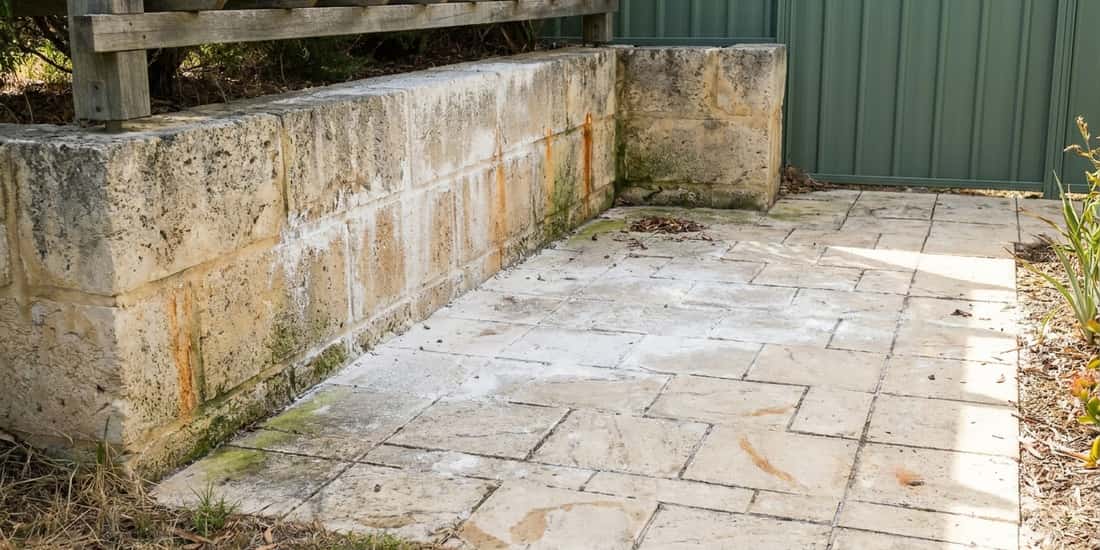
Algae and biofilm. This is the single biggest cause on Perth paving and it is nothing like ordinary dirt. Algae form a living film across the surface, often so thin that homeowners see it as nothing more than a slight darkening or a greenish cast in the shade. Dried out, it becomes firm and unremarkable. Rewet, it swells into a soft, gelatinous layer that behaves like a lubricant between shoe and stone. This is why the slipperiness appears to arrive overnight with the first rain. The growth was already there, waiting for water.
Biofilm is the broader version of the same story: a mixed community of algae, bacteria and organic matter bound in a slick matrix. It thrives where moisture lingers and light is filtered, which describes a great deal of Perth paving. South facing entrances, paths under peppermints and jacarandas, the strip that catches reticulation overspray every second morning, anywhere a wall or pergola holds the shade past mid morning. Those same conditions carry the growth through summer on irrigation alone, which is why plenty of properties never get a genuinely clean slate. In the dampest corners it progresses past film into moss in the joints and lichen crusts on the paver faces, by which point the hazard has been building for a long time.
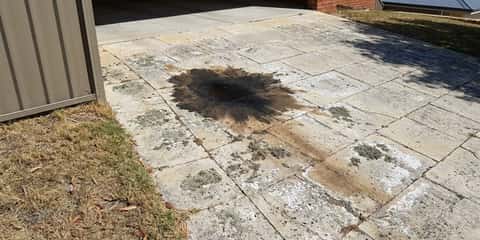
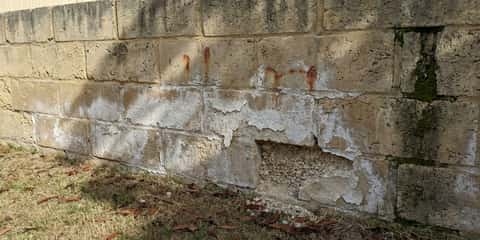
Limestone dust and residue. This is a distinctly local factor. Limestone is everywhere in Perth, in retaining walls, garden edging, capping, crushed base material and the pavers themselves. It is soft, and it sheds. Fine limestone dust washes down walls and across paving, settles into the surface profile and hardens into a pale, chalky film. Dry, it feels like nothing much. Wet, that fine particulate turns into a slurry that rolls underfoot in the way loose grit does on a tiled floor. Properties with limestone retaining above paved areas see this year after year, in the same downslope pattern.
Pollen and organic film. Through the flowering months, pollen settles and combines with dust and tree drip to form a waxy film that gets slick when wet. More importantly, it feeds the algae. Organic debris is fertiliser. Leaf litter left in a corner over winter, bark from mulched beds, fruit drop from an olive or a fig: all of it breaks down into the nutrient base that makes growth take hold faster the following season.
None of these causes are structural. They sit on the surface. Remove them properly and the original slip resistance of the paver is still underneath.
For businesses and strata, this is liability rather than nuisance
At a home, a slippery path is a hazard to people you know. At a commercial or strata property it is a hazard to people who have no idea it is there, and the consequences are framed differently.
Anyone who occupies, manages or controls a property where the public, tenants, staff, residents or visitors walk carries a duty of care for their safety on that site. For strata schemes, common property paving sits squarely within the remit of the body corporate and its manager. For a cafe, medical suite, childcare centre or retail tenancy, the paved entrance is part of the environment the business puts people into.
Entrances and walkways are where this concentrates. They take the highest traffic, they are the point where people are least likely to be watching their feet, and they are frequently the wettest part of the site. Rain blown under an awning, a covered walkway that stays damp all day, runoff from a downpipe crossing a footpath: these are the places where biofilm establishes fastest.
The difficult element for property managers is foreseeability. A surface that has been visibly discoloured through two winters and reported by residents is not a surprise event. A documented, regular cleaning programme changes that picture considerably, because it demonstrates the risk was identified and managed as routine rather than left until something happened.
Why a sealer on its own is not the answer
The instinctive fix, once the cause is understood, is to buy a sealer with an anti-slip additive and treat the area. It is a reasonable instinct and it is half right.
The problem is sequence. Sealers and coatings bond to the surface they are applied to. If that surface still carries algae, biofilm or limestone residue, the product bonds to the contamination rather than the paver. The growth is not killed by being covered, it is given a sheltered, moist environment directly beneath a film. Within a season or two it reappears, either as blotching under the coating or by lifting the coating off in patches. The repair is then harder than the original job, because the failed product has to come off before anything else can happen.
There is a second issue. Not all sealers help. Gloss and wet look finishes can reduce wet slip resistance in their own right, which means a homeowner trying to solve a slip problem can make it worse while making the paving look excellent. Anti-slip additives address this by reintroducing texture, but they need to be specified for the surface and the traffic, and they wear at the points where footfall is heaviest.
Treated properly, coatings earn their place. A clean, dry, correctly prepared surface with a suitable protective coating stays cleaner for longer and slows the return of biofilm. That is a maintenance advantage, not a permanent cure. The coating buys time between cleans. It does not replace them.
A checklist for dirty versus genuinely hazardous
Discolouration and danger are not the same thing. Work through this checklist before deciding how urgent the job is.
- The wet test. Wet a small area, press down with the ball of your foot and twist gently. Any sense of the surface moving under you, or a slight smearing sensation, indicates a film rather than grip.
- The finger test. Rub a damp patch firmly with a fingertip. If it feels slick or your finger comes away with a faint green or grey smear, you have biofilm.
- Colour in the shade. Compare a shaded section with one in full sun. A darker, duller, slightly uniform tone in the shade is early algae, well before it reads as green.
- Chalky runoff. After rain, look for pale streaking or milky water pooling below limestone walls or edging.
- Joint growth. Moss or weed in the joints signals moisture retention across the whole area, not just the joints.
- Behavioural evidence. People stepping around a section, taking the grass instead of the path, or reaching for a handrail they never used to need. At a commercial site, treat any near miss or complaint as a trigger.
- Location weighting. Anything above matters more at an entrance, on a ramp, at the top of steps or beside a pool than in the middle of a courtyard.
Two or more of these, particularly in a high traffic location, and the paving has stopped being a cosmetic issue.
Building it into a schedule instead of a crisis
The lasting fix is unglamorous. Clean the surface properly, protect it, and repeat on a cycle that matches the site rather than waiting for a slip to remind you.
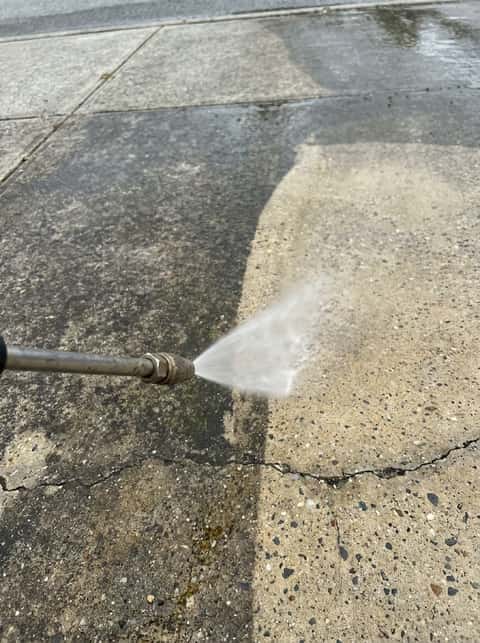
Professional pressure cleaning does the work that matters most, which is removing the film and the organic matter from the surface profile without damaging it. Technique is genuinely important here. Too much pressure on soft limestone or aged concrete pavers erodes the very texture that provides grip, and an aggressive clean can leave paving looking better and performing worse. Correct pressure, appropriate nozzle selection and suitable pre treatment for biological growth matter as much as the machine.
Nanocoating maintenance is the second half. Applied to a properly cleaned and dry surface, it reduces how readily water, dust and organic matter cling to the paver, which slows the rate at which biofilm re establishes. On a scheduled programme, each subsequent clean does less work and the surface spends more of the year with its grip intact.
Timing follows Perth's seasons. A clean before the wet season strips out the growth that would otherwise bloom with the first sustained rain, and a clean after it resets the surface for summer. Shaded areas, irrigated surrounds, commercial entrances and strata walkways generally warrant more. The same logic that sets cleaning intervals for other hard surfaces applies here, and our guidance on how often you should pressure clean your driveway in Perth is a sensible starting point for setting a patio and walkway cycle alongside it.
If your paving has turned slick this winter, the answer is almost certainly not new pavers and not a tin of sealer. It is a proper clean, a suitable protective treatment and a schedule that stops the growth getting established again. Talk to Purified Group’s Perth pressure cleaning team about assessing your paving and setting up a maintenance cycle that suits your site.
Frequently Asked Questions
Why are my patio pavers slippery when wet but fine when dry?
Because the slip risk comes from a thin biological film, not the paver itself. Algae and biofilm are firm and almost invisible when dry, but they absorb water and turn gelatinous when wet, creating a lubricating layer between your shoe and the surface texture underneath.
Will a sealer stop my pavers being slippery?
Only partly, and only if the surface is properly cleaned and dry first. Sealing over existing algae or biofilm traps the growth underneath, and some gloss sealers reduce wet grip on their own. Sealers and coatings work as a maintenance aid, not as a substitute for cleaning.
How often should Perth paving be cleaned to stay slip resistant?
Most Perth properties do best with a clean heading into the wet season and a second one after it, with shaded, irrigated or high traffic areas often needing more. Entrances and walkways at commercial and strata properties usually justify a more frequent cycle.
Is slippery paving a liability issue for businesses and strata schemes?
It can be. Occupiers and managers of commercial and common property have duty of care obligations to people using the site, and a known slippery entrance or walkway that has not been addressed is a foreseeable risk. Documented cleaning schedules matter in that context.
Can pressure cleaning make pavers more slippery?
Poorly executed cleaning can. Excessive pressure on soft limestone or aged concrete pavers can polish or erode the surface profile that provides grip. Correct pressure, nozzle selection and technique for the material matter as much as the cleaning itself.