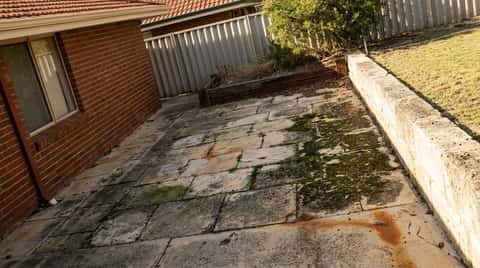
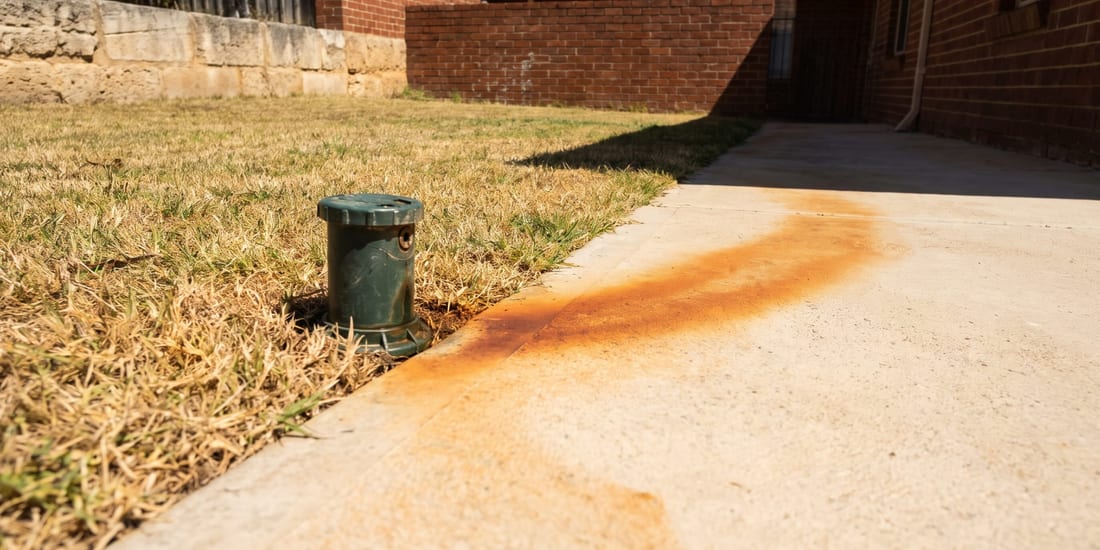
Orange fans across the driveway. A rust-coloured arc on the limestone retaining wall. A band of brown along the edge of the path that follows the exact shape of a sprinkler throw. If you have bore-fed reticulation in Perth, you have almost certainly seen one of these, and you have probably scrubbed at it with something from the laundry cupboard and got nowhere.
Rust marks on concrete from reticulation are one of the most common exterior staining problems in this city, and one of the most frequently mishandled. The stain itself is only half the issue. The other half is the sprinkler that keeps putting it back.
Why Perth bore water stains concrete in the first place
Perth sits on sandy soils over a shallow groundwater system, and a large number of homes draw irrigation water directly from it. That water never goes through a treatment plant. It comes out of the ground carrying whatever the aquifer holds, and across much of the metropolitan area that includes dissolved iron.
Underground, the iron is in a dissolved form and the water looks clear when it first leaves the nozzle. The moment it hits the air and sprays across your driveway, it oxidises. Dissolved iron becomes iron oxide, which is rust, and rust is a pigment. It settles into the open pores of the concrete, the sun bakes it in, and the next watering cycle lays down another thin coat.
This is why the staining is cumulative rather than sudden. A new bore might show nothing for the first season. Three summers later there is a permanent orange shadow where the spray lands. It is also why the stain mirrors the irrigation pattern so precisely. You can usually stand on the verge and point at the exact sprinkler responsible, because the stain is shaped like its throw: a fan, a half circle, a narrow stripe where a misaligned head is hitting the slab instead of the lawn.
Iron content varies enormously from suburb to suburb and even from one street to the next, which is why your neighbour’s driveway can be spotless while yours looks like it has been spray-painted. It is not a sign that your water is dirty in any health sense. It is a mineral issue, not a hygiene one.
How to tell the difference between rust and other driveway stains
Getting the diagnosis right matters, because the treatment for one stain can set another one permanently. Four things commonly discolour Perth driveways, and you can usually tell the difference by colour, pattern and texture.
Iron staining is orange through to reddish brown. It sits in a geometric pattern that relates to water movement: arcs, fans, stripes, or a stained line where runoff drains across the slab. It has no texture. Run your hand over it and the surface feels the same as the clean concrete beside it. It does not darken when it rains.
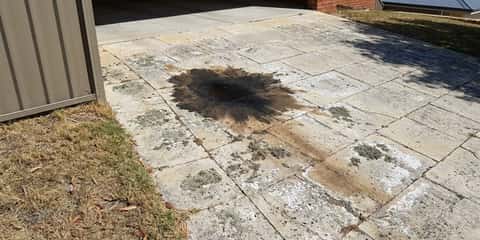
Oil and transmission fluid are grey, black or dark brown and sit in blobs and drips under where a car parks. The pattern is random rather than geometric. Fresh oil often shows a slight sheen and the area may repel water rather than absorbing it.
Mould, algae and lichen are green, grey-green or black, and they favour shade, the southern side of the house, under eaves and wherever moisture lingers. Biological growth gets darker and sometimes slimy after rain, and lichen in particular has a raised, crusty texture you can feel.
Tannin staining from jacaranda, gum, fig and other leaf litter is tan to deep brown and takes the outline of the leaves or the drip zone of the tree. It often appears seasonally, after flowering or leaf drop.
If the mark is orange, geometric and smooth, you are dealing with iron. If you are mixing problems, which is common on a driveway that gets both bore spray and overhanging trees, the order of treatment matters and that is a good reason to get advice before starting.
Why the substrate changes everything
Rust removal is chemistry, and the chemistry is only safe if the surface can take it. This is the part most DIY attempts get wrong.
Standard concrete is cement-based, which means it is alkaline and reacts with acid. A correctly chosen, correctly diluted acidic rust treatment can lift iron from concrete without visible harm, but the margin is not infinite. Too strong, too long, or left to dry on the surface and you get etching: a dull, slightly roughened patch that reads as a lighter ghost of the stain you just removed. You have swapped an orange mark for a white one.
Limestone, travertine and reconstituted limestone are calcium carbonate. Acid does not etch these slowly, it dissolves them. Hydrochloric acid will fizz on contact and strip surface material almost immediately, leaving pitting and a permanently changed texture. Given how much Perth limestone edging and paving sits directly under reticulation spray, this is a very real risk. Carbonate surfaces need a specialist iron remover formulated for stone rather than a general-purpose acid.
Exposed aggregate is a mixed surface: a cement matrix holding decorative stone. Acid attacks the matrix faster than the stone, so an aggressive treatment loosens the bond and starts popping pebbles out. The surface may also be sealed, and most sealers react badly to acid, going cloudy, blotchy or peeling. Once a sealer is damaged, the fix is stripping and resealing the whole area rather than touching up a patch.
Clay and concrete pavers vary. Some clay pavers are dense and tolerant, while pigmented concrete pavers can lose colour. Jointing sand between pavers is also easily washed out by heavy rinsing, which creates a separate problem to fix.
What is reasonably safe to try yourself
If you have ordinary, unsealed, sound grey concrete and a light stain, there is a sensible DIY window.
Start with the gentlest option that could work. A dedicated rust remover from a hardware store, ideally oxalic-acid based rather than hydrochloric, applied to a pre-wetted surface, kept wet for the stated dwell time and then rinsed thoroughly, will often make a meaningful difference on recent staining. Pre-wetting matters because dry concrete pulls the chemical deep into the slab where it is hard to neutralise.
Always test an inconspicuous patch first, near the garage door or behind a gate, and give it a day to dry before judging the result. Wet concrete lies about colour.
The risk line starts here:
- The surface is limestone, travertine, sandstone or any carbonate stone.
- The surface is sealed, coloured, stencilled, honed or polished.
- The surface is exposed aggregate.
- The stain is old, deep and widespread rather than a light recent patch.
- You are considering a stronger acid because the first attempt did not work.
That last point causes more damage than anything else. When a mild product underperforms, the instinct is to escalate concentration. Iron staining does not respond proportionally to strength, but concrete damage absolutely does. You reach the point of etching long before you reach the point of a clean slab.
There is also the runoff question. Acidic rinse water heading into garden beds, onto lawn or down a stormwater drain is not something to be casual about. Containment and neutralisation are part of doing the job properly.
Fix the sprinkler or the stain simply returns
Cleaning the driveway without changing the irrigation is a treadmill. Within a season or two you are back where you started.
Re-aim or change the heads. The most common cause is a sprinkler throwing well past the lawn edge. Swapping a full-circle head for a half or quarter pattern, fitting an adjustable nozzle, or simply rotating the head so its arc stops at the garden edge often solves the problem outright. Pop-up heads that have been knocked out of alignment by a mower or a car tyre are worth checking individually.
Reposition the head. If a sprinkler sits right against the driveway edge, moving it back into the lawn by even a short distance can keep the spray off the concrete entirely.
Check pressure. Over-pressurised systems atomise water into fine mist that drifts much further than the designed throw. That drift is what stains fences, walls and garage doors, not just paving. A pressure regulator can tighten up the pattern.
Treat the water. For bores with genuinely high iron, in-line iron sequestering treatments are injected into the reticulation so the iron stays dissolved and does not oxidise onto surfaces. These require ongoing refills and correct dosing, and they suit properties where the staining is severe and widespread rather than confined to one sprinkler.
Water at the right time. Running the system in the cooler part of the watering window, in line with Perth’s watering roster, means less evaporation and less concentrated mineral deposit baking onto hard surfaces.
When to bring in a professional
Call someone when the stain covers a large area, when the surface is limestone or decorative, when the staining has been building for several years, or when you have already tried a supermarket product and seen no change.
Professional treatment differs from DIY mainly in the chemistry available and the control applied. Commercial iron removers can be matched to the substrate, applied at a dwell time suited to the stain depth, and rinsed under controlled pressure that lifts the dissolved iron without blasting the surface. Soft washing is often used on stone and sealed surfaces where high pressure would do the damage the acid did not. Runoff is managed rather than allowed to wander.
There is an economic argument too. Repeated attempts with the wrong product cost money and progressively degrade the surface, and etched, patchy concrete cannot be cleaned back to normal. Resurfacing costs far more than treating a stain correctly the first time.
Once the slab is clean and the sprinklers are sorted, maintenance becomes straightforward. Keeping to a sensible interval stops new iron deposit from consolidating, and our guide on how often you should pressure clean your driveway in Perth sets out what that interval looks like for local conditions.
If the rust has been building for a few summers and you would rather not gamble on the chemistry, Purified Group’s Perth pressure cleaning team can assess the substrate, match the treatment to it and get the surface back to something you are happy to park on.
Frequently Asked Questions
Will pressure washing alone remove rust marks from concrete?
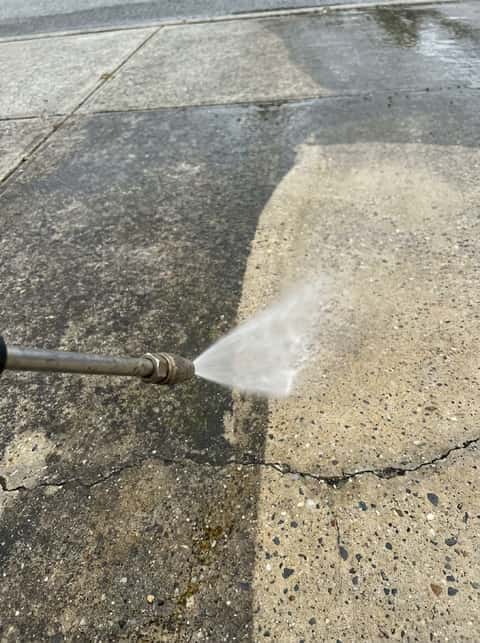
Usually not. Pressure washing lifts the dirt and biological growth sitting on top, but iron staining has soaked into the pores of the slab. It needs a chemical treatment that converts or dissolves the iron, followed by a thorough rinse.
Can I use hydrochloric acid on rust stains from my reticulation?
It is a poor choice for rust and a dangerous one on limestone, travertine or honed concrete. Hydrochloric acid attacks the cement and carbonate in the surface faster than it touches the iron, which leaves a lightened, etched patch where the stain used to be.
Why do the rust marks come back after cleaning?
Because the source has not changed. If a sprinkler is still throwing bore water across the driveway, fresh iron is deposited every watering day and the stain rebuilds within weeks to months.
Does scheme water cause rust staining too?
Rarely. The staining almost always traces back to bore water drawn straight from the ground, which carries dissolved iron that has never been through treatment.
Will the stain ever come out completely?
On sound, non-sealed concrete, most iron staining responds well. Very old staining on porous or decorative surfaces may lift to a strong improvement rather than a perfect match, which is why early treatment helps.