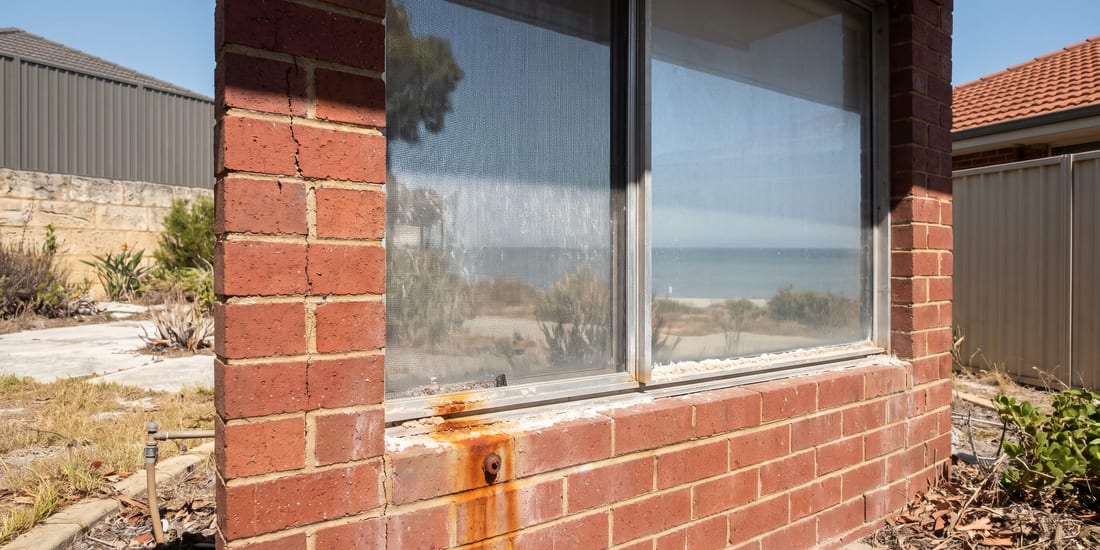
Anyone living within sight of the Indian Ocean knows the look. The glass is not dirty exactly. It just reads slightly flat, as though someone breathed on the whole pane at once, and the view out to the water loses its crispness.
That is salt film, and in Perth it behaves differently to the salt film described in advice written for Sydney or the Gold Coast. The salt arrives the same way. What happens to it afterwards does not.
What salt film actually is
Breaking surf throws fine droplets of seawater into the air. The water evaporates and leaves airborne salt crystals, which the sea breeze carries inland. On the Perth coast that breeze has a name and a timetable. The Fremantle Doctor arrives most summer afternoons from the south west, which is why the worst affected glass in any given house is usually the western and south western elevations, not simply the side facing the beach.
Salt is hygroscopic, meaning it pulls moisture out of the air, so overnight dew partially dissolves the deposit and the morning sun dries it again. Each cycle packs the layer a little tighter against the surface. After enough cycles you are no longer looking at dust sitting on glass. You are looking at a bonded film.
Salt film or bore water staining? Telling them apart
Plenty of Perth homes have both problems on the same wall, which is why this gets confusing. The two need different treatment, so it is worth learning to read the difference.
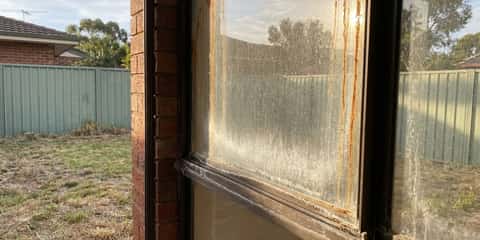
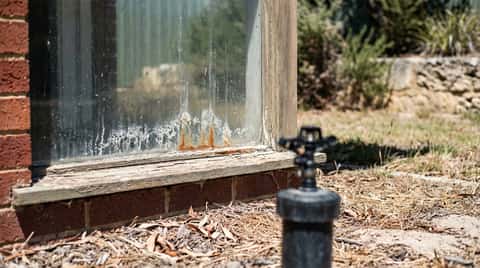
Pattern. Salt film is broad and even. It covers the full pane, usually heavier at the top where run off has not reached, and it extends across every window on the exposed elevation at roughly the same intensity. It also settles on frames, flyscreens and door hardware. Bore water staining is directional. It arrives as a spray pattern: arcs, fans, or a dense band across the lower half of the glass where a reticulation head throws onto it, and it climbs only as high as a sprinkler can reach.
Edge definition. Salt film has no edges. Bore water staining does, because each droplet dries in place and leaves a defined ring of minerals. Hundreds of overlapping rings produce the classic spotted look.
Colour. Salt film is colourless and reads as haze or dullness. Perth bore water frequently carries dissolved iron, so reticulation staining often has a tan or rust tint, particularly on sills and render below the glass.
Response to plain water. This is the most reliable test. Wet a small section with clean water and leave it thirty seconds. Salt film begins to soften and will wipe away with a clean microfibre. Bore water scale will not. It is a mineral deposit that is genuinely stuck, and in bad cases it has begun to bond into the surface of the glass itself.
If plain water lifts it, you have a cleaning job. If it does not, you have a restoration job, and that is a different conversation.
Why Perth bakes salt on faster
This is where east coast advice stops being useful. Humid coastal cities hold high humidity around the clock, which keeps salt deposits damp for long periods. A film that stays moist stays loose, and regular year round rainfall rinses a reasonable proportion of it away before it consolidates.
Perth gives salt the opposite conditions. Summer mornings may be humid near the coast, but humidity collapses through the middle of the day, the glass dries completely, and on a west facing pane the surface temperature climbs well beyond air temperature. That heat hardens whatever remains. Then the afternoon breeze delivers a fresh load onto an already dried layer.
Add the UV. Perth sits under some of the strongest ultraviolet exposure of any Australian capital. UV accelerates the breakdown of whatever else is on the glass, including airborne organic matter and the remains of previous cleaning products, so salt binds into that mixture rather than sitting on clean glass. UV also degrades the polymer coatings, seals and gaskets around the opening, giving salt somewhere to lodge.
The practical consequence is a compressed timeline. A deposit that might remain hose removable for weeks in a humid climate can consolidate into a bonded film far sooner on a hot, dry, west facing Perth elevation. Our long dry season also means months can pass with no meaningful rinsing rain at all.
Exposure zones and realistic cleaning frequency
Generic advice says "clean more often if you live near the beach", which is not much help when the house two streets back has visibly cleaner glass than yours. Perth’s coastal topography, particularly the limestone ridge running behind much of the shoreline, creates sharp differences over short distances. Think in bands rather than kilometres.
Band one: the exposed beachfront strip. Properties with a direct line of sight to breaking surf, no significant dune or built form in between. Think the front rows at Cottesloe, Swanbourne, City Beach, Scarborough, Trigg, North Beach, Mullaloo, Burns Beach, North Coogee and the Rockingham foreshore. Salt arrives daily in summer, and glass noticeably hazes between cleans. Quarterly cleaning suits most of these homes, and the west facing elevations of multi storey builds often warrant more frequent attention than the rest of the house.
Band two: mid distance, still in the breeze. A few streets to a few kilometres back, with partial shelter from housing or vegetation but still squarely in the path of the sea breeze. Doubleview, Wembley Downs, Duncraig, Beaconsfield, Spearwood, Hamilton Hill and Bicton fall here. Salt builds more slowly and you will usually see it as gradual dulling rather than a weekly film. Two cleans a year generally holds the line.
Band three: behind the ridge or well inland. Innaloo, Balcatta, Morley, Dianella, Canning Vale and similar. Salt is a minor contributor compared to dust, pollen and reticulation overspray, and annual cleaning is often sufficient. Bore water staining may well be the dominant problem instead.
Worth noting that the lower Swan River is brackish, so riverfront homes around East Fremantle and Mosman Park pick up a genuine salt load despite not being oceanfront.
What happens if you leave it
Salt is not strongly corrosive to glass on its own. The damage comes from what a long standing film does and what it collects.
First, etching. A bonded salt film holds moisture against the surface and traps everything else that lands on it, including the calcium and magnesium minerals from reticulation overspray and the alkaline residue of cleaning products. Left on hot glass through a Perth summer, that mixture can begin to etch into the surface rather than sit on it, leaving a permanent cloudiness that no amount of later cleaning will lift. Etching is not reversible by washing. At that point the options are professional glass restoration or replacement.
Second, scratching. Dried salt is a hard, fine abrasive. Dry wiping a salted pane, or going at it with a squeegee and insufficient water, drags those crystals across the glass and leaves fine scratches. A great deal of the hazing blamed on salt is actually accumulated micro scratching from well intentioned cleaning.
Third, and most expensively, the hardware. Perth coastal builds lean heavily on powder coated aluminium frames, aluminium sliding door tracks, stainless fittings and glass balustrade spigots. Salt trapped in a track or behind a gasket stays damp far longer than salt on open glass, which is exactly the condition that drives corrosion. You see it as white blooming and pitting on the powder coat, stiff rollers, doors that need a shove, seized window winders, and tea staining on supposedly marine grade stainless. Salt also works into rubber seals and silicone that Perth UV is already ageing faster than it would elsewhere.
What a nanocoating changes, and what it does not
Hydrophobic glass coatings have a legitimate place on exposed coastal windows, and they are also routinely oversold.
What they do: a well applied coating fills microscopic irregularities in the glass and presents a slick, water repellent face. Salt lands on it but bonds far less firmly, so the next rinse lifts it with much less effort. Water sheets off rather than beading and drying in place, which reduces the wet and dry cycles that consolidate a film and the dwell time that leads to etching.
What they do not do: stop salt landing. Your windows still receive the same aerosol load, so you will still see haze between cleans, just a softer version of it. Coatings are also consumable. UV, abrasive cleaning and harsh chemicals wear them down, and coastal Perth is about as aggressive as the conditions they get tested in. They need reapplication, and they need to be cleaned in a way that does not strip them.
A coating lowers the effort and risk of each clean. It is not a substitute for cleaning.
Why pure water suits salt film particularly well
The full case for pure water cleaning is made in our comparison of pure water window cleaning and traditional methods, so this is just the salt specific part.
Salt is soluble, and that is the whole advantage. Purified water with the dissolved minerals stripped out is aggressively keen to pick up dissolved solids, so it dissolves and carries salt away rather than relying on mechanical scrubbing. Less scrubbing means less chance of dragging salt crystals across the glass and scratching it.
Tap water cleaning struggles on two fronts. Perth scheme water carries its own dissolved minerals, so rinsing a salted window with it leaves a residue behind. And a squeegee approach relies on contact and friction, which on a heavily salted pane is precisely what you want to minimise.
Reach matters too. The windows that collect the most salt are frequently the highest and most exposed, and an extendable pure water system can clean them, along with the frames and sills where salt does the real damage, without the cost of access equipment.
If the view out to the ocean has gone soft and you are not sure whether you are dealing with salt, bore water or years of accumulated micro scratching, it is worth having someone look at it before you attack it with a cloth. Purified Group’s Perth window cleaning works across the coastal suburbs and can tell you which of the three you have and what a sensible cleaning interval looks like for your exposure.
Frequently Asked Questions
How do I know if my windows have salt film or bore water staining?
Salt film covers the whole pane fairly evenly, feels slightly greasy or gritty, and softens quickly with plain water. Bore water staining appears as hard, sharply defined spots or arcs in the spray pattern of a sprinkler, often with an orange tint, and does not soften when wet.
How often should coastal Perth windows be cleaned?
On the exposed beachfront strip, many households find quarterly cleaning keeps glass clear, with the most exposed west-facing elevations needing attention more often. A few kilometres inland, twice a year is usually enough. Behind the coastal ridge, annual cleaning is often fine.
Can salt permanently damage window glass?
Salt itself is not strongly corrosive to glass, but long-dried deposits are abrasive and can trap minerals that etch the surface. Dry wiping a salted pane can also leave fine scratches that never come out. The bigger risk is to aluminium frames, tracks and hardware.
Does a nanocoating stop salt building up on windows?
No. A coating reduces how firmly salt bonds to the glass and makes removal easier, but salt aerosol still lands on the surface. Coatings also wear down over time, particularly under strong UV and abrasive cleaning.
Is rain enough to wash salt off windows?
Rarely, and almost never in a Perth summer. Light rain tends to wet and redistribute the deposit rather than rinse it, and it dries into a patchier film than before.