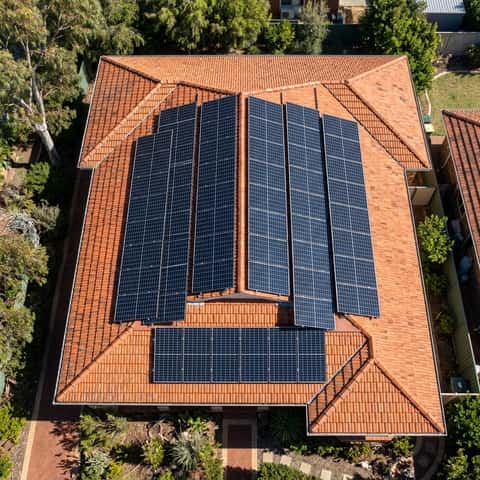
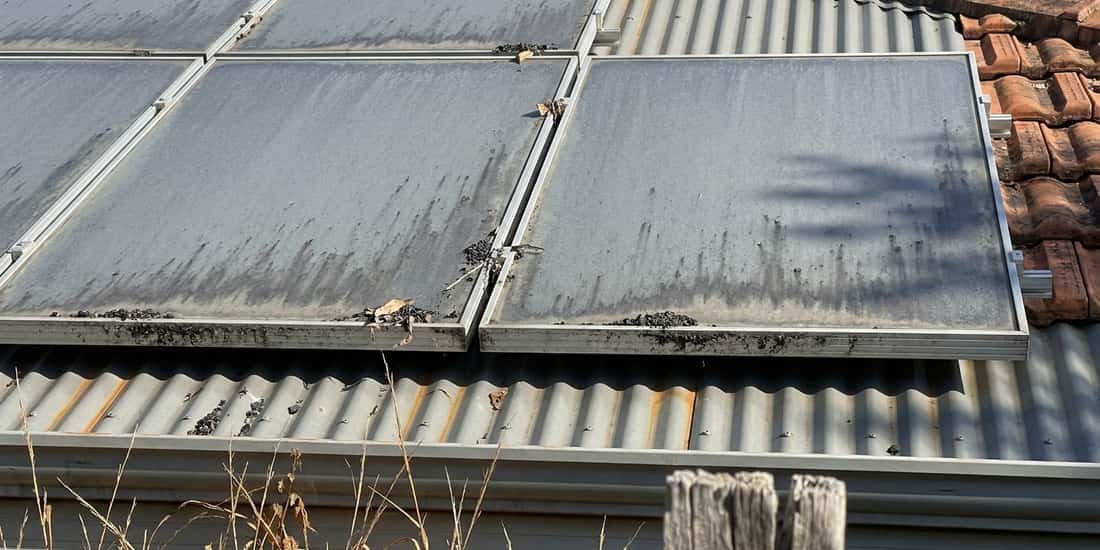
Bushfire ash is one of the few things that can knock a solar array's output down noticeably in a single afternoon. Perth homeowners in the hills, the outer eastern and northern suburbs, and anywhere downwind of bushland get a reminder of it most summers. A smoke haze rolls through, and by the next morning the panels have a grey film over them and the app shows a dip.
The advice you will find online is usually some version of "hose it off, or ring your installer." Neither is wrong exactly, but neither accounts for what makes a Perth roof different: the water most of us have easy access to outside, the roof materials we build with, and the fact that a lot of ash arrives here in the middle of a heatwave when the glass is already too hot to touch.
Here is a more useful way to think it through.
Why ash is not just dust
Ordinary Perth dust is mostly fine sand and pollen. It sits loosely, it washes off in the first decent rain, and it is relatively forgiving of a wipe.
Bushfire ash behaves differently in three ways that matter.
First, it is abrasive. What lands on your roof is not only soft carbon powder. It also includes gritty mineral residue and small angular fragments from burnt vegetation and soil. Dragged across glass under pressure, that is an abrasive slurry.
Second, it is alkaline and slightly greasy. Ash carries soluble salts and fine unburnt oils from eucalypt foliage. Add overnight dew or a light shower, and what was loose powder in the evening becomes a bonded film by morning. That film does not rinse away the way dust does.
Third, it holds onto the glass. Anti-reflective coatings on modern panels have a microscopic texture. Ash particles settle into it, and the longer they stay, the harder the surface gets to bring back.
The practical takeaway is that ash rewards prompt attention and punishes force.
Safety first, and that is not a throwaway line
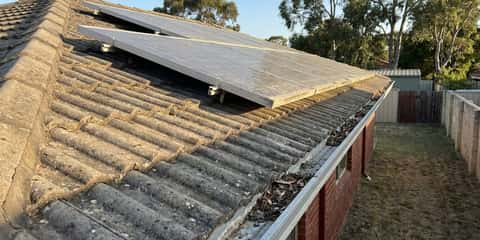
Do not go up on a roof while a fire is still active nearby, while smoke is still settling, or while emergency services are working the area. Ash makes any roof surface slippery, and it does it invisibly. On profiled steel sheeting it acts like a dry lubricant across an already smooth surface. On concrete or terracotta tiles it fills the texture that normally gives your shoe some grip.
Then there is the roof itself. Older terracotta and concrete tiles in the established suburbs crack under foot in ways you may not notice until the next storm shows up inside the ceiling. Tile roofs are the single most common reason a DIY solar clean turns into a bigger repair bill. Add a second storey and the calculation stops being about cleaning at all. It becomes a question of whether you own the right fall protection and know how to use it.
If your array sits on a two-storey roof, on brittle tiles, or on a pitch steep enough that you would hesitate, the DIY conversation is over. That is not caution for its own sake. It is the honest answer.
The hose problem, and it is a Perth problem
Say you have a single-storey steel roof, safe access, and a light ash haze. The instinct is to grab the garden hose. Two things go wrong.
The first is mechanical. A hose stream shifts ash, but it also pushes it across the glass and into the frame edges, and if you follow up with a brush or a squeegee you are grinding those abrasive particles into the coating. Fine scratching is permanent, it scatters light, and no amount of later cleaning recovers it.
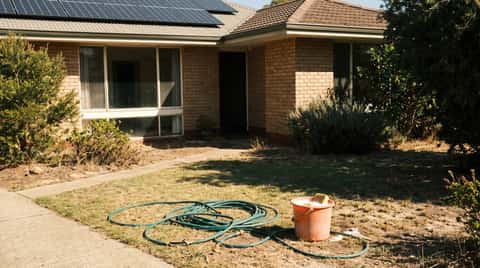
The second is chemical, and this is where Perth differs from most national advice. Plenty of Perth homes run garden taps and reticulation off a bore. Perth groundwater is commonly high in iron and dissolved minerals, which is exactly why so many local fences and paths carry orange staining. Spray that onto panel glass in summer, and it flashes off in minutes, leaving mineral deposits and iron staining behind. You have swapped a grey film for a mottled one that is harder to remove than the ash was. Scheme water is better, but Perth mains water still leaves spotting when it dries on hot glass.
If you are going to rinse, do it early in the morning before the roof heats up, use scheme water rather than bore water, keep the pressure gentle, and resist the urge to scrub. Accept that you are reducing the ash load, not finishing the job.
Why a pure water rinse is the safer method
Professional solar cleaning in Perth generally uses deionised or purified water fed through a soft brush on a telescopic pole from ground level or from a safe working position. Two reasons this suits ash specifically.
The water has had its minerals stripped out, so there is nothing left behind when it evaporates. No spotting, no iron staining, no scale film shading the cells. The panels dry clear without anyone touching them with a cloth.
And the method lifts and floats debris away rather than dragging it. Purified water is chemically aggressive towards dirt, so it does the loosening while the soft bristles simply keep contact light. For an abrasive contaminant like ash, that difference is the whole point.
It also keeps people off fragile tiles and away from roof edges, which matters more than the cleaning result if anyone in the household is the one who would otherwise be up there.
When it is a clean, and when it is an inspection
Use the severity of what landed on your roof to decide.
A light ash haze. Smoke passed over, panels have an even grey film, nothing charred on the roof. This is a cleaning job. Get it done before the next dew or shower bonds the film, and check your output afterwards.
A heavy fall with debris. Visible black flecks, leaf litter and charred fragments in the panel frames, ash packed in the gutters and around the array's mounting rails. Still a cleaning job, but a thorough one that includes the frame channels and drainage paths, because trapped organic material holds moisture against the frame and encourages corrosion.
Anything suggesting heat or ember exposure. Discolouration or yellowing on the glass, warped or lifted frames, bubbling or perishing on cable insulation, melted cable ties, scorching on roof sheets or tiles near the array, or fire retardant residue from an aerial drop. This is not a cleaning decision. Book an inspection, photograph everything before it is touched, and speak to your installer or a licensed electrician before the system goes back to normal operation. A clean can come afterwards.
If output stays low after a proper clean, that is also worth an electrical look rather than a second wash.
Fitting it into your normal routine
Ash is an event, not a schedule. It sits on top of the regular Perth cycle of summer dust, spring pollen and coastal salt that already dictates how often panels need attention. If you are unsure what that baseline should look like for your suburb and roof, our guide to how often you should clean residential solar panels in Perth works through it.
For an ash event specifically, the pattern is simple. Assess safely from the ground, resist the hose and the brush, and get the panels cleared properly before the film sets.
If ash has come through your area and you would rather have it handled without anyone in the house climbing onto a hot tile roof, Purified Group’s Perth solar panel cleaning uses a pure water, pole-fed method suited to exactly this kind of contamination.
Frequently Asked Questions
Can I just hose bushfire ash off my solar panels?
A hose moves the worst of a light ash fall, but it also drags abrasive particles across the glass and leaves mineral spotting once the water dries. If you do rinse, use scheme water rather than bore water, do it early in the morning while the glass is cool, and never scrub.
Why is dry brushing bushfire ash off panels a bad idea?
Dry ash contains gritty, angular particles. Pushing them across the anti-reflective coating with a brush or broom is effectively sanding the glass, and the fine scratches that result are permanent.
Should I clean my panels myself or call someone after a bushfire?
A light haze on a single-storey roof you can already access safely is a reasonable DIY rinse. Heavy ash, charred debris, a tile or two-storey roof, or any sign of heat exposure calls for a professional clean and inspection instead.
How soon after a bushfire should panels be cleaned?
Once the area is declared safe and the roof is not wet or smoke-affected. Leaving ash to sit through a rain shower or a humid night is what turns loose dust into a bonded film, so sooner is generally better.
Does bore water damage solar panels?
Bore water does not damage the glass itself, but the iron and dissolved minerals common in Perth groundwater bake onto hot panels and leave staining and scale that shade the cells. Deionised water rinses clean and leaves nothing behind.