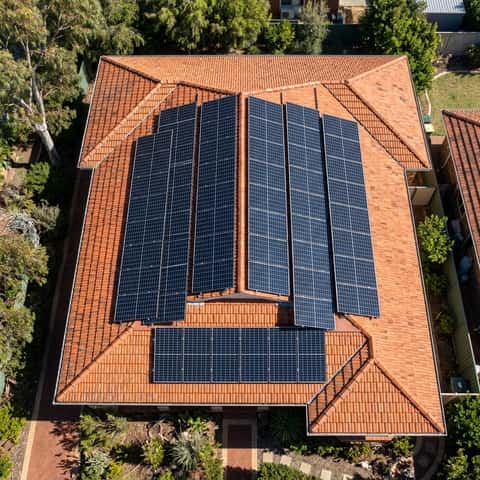
Solar panels are marketed as a fit and forget purchase, and for the most part that is fair. There are no moving parts, nothing needs oiling, and a well installed array will sit there quietly working for decades. The one thing it does need is a clear sheet of glass, and that is the part Perth's climate works hardest against.
So what actually happens if you never clean them? Not much, at first. Then a slow, unglamorous decline. Then, in a smaller number of cases, damage that no amount of cleaning will reverse. The timeline below maps how that tends to unfold on a typical Perth roof, and where the line sits between grime you can wash off and marks you are stuck with.
The first six months: a film you cannot see from the ground
Perth panels start collecting material immediately. In the dry months it is fine limestone and sand dust, pollen through spring, and whatever the easterlies carry in from the hills. Homes in newer estates get construction dust, which is finer and stickier than beach sand. Coastal suburbs get a salt aerosol on the sea breeze that settles as an invisible haze and attracts everything else to it.
At this stage the effect is uniform and mild. Output drifts down slightly, and because it happens across the whole array at once, nothing looks wrong in your monitoring app. You would need to compare like for like against a previous year to notice, and even then the weather muddies the comparison.
What matters here is that everything is still fully reversible. A wash returns the glass to as new. There is no residue bonded to the surface, no biological growth, no etching. If you clean at this point you are simply recovering yield.
Six to twelve months: rain stops being enough
The usual objection is that rain will handle it. In Perth, rain arrives mostly between May and August, exactly when the sun is lowest and daily output is at its annual minimum. The cleaning happens when you least need it and is absent through the summer months when your array is doing its heaviest work.
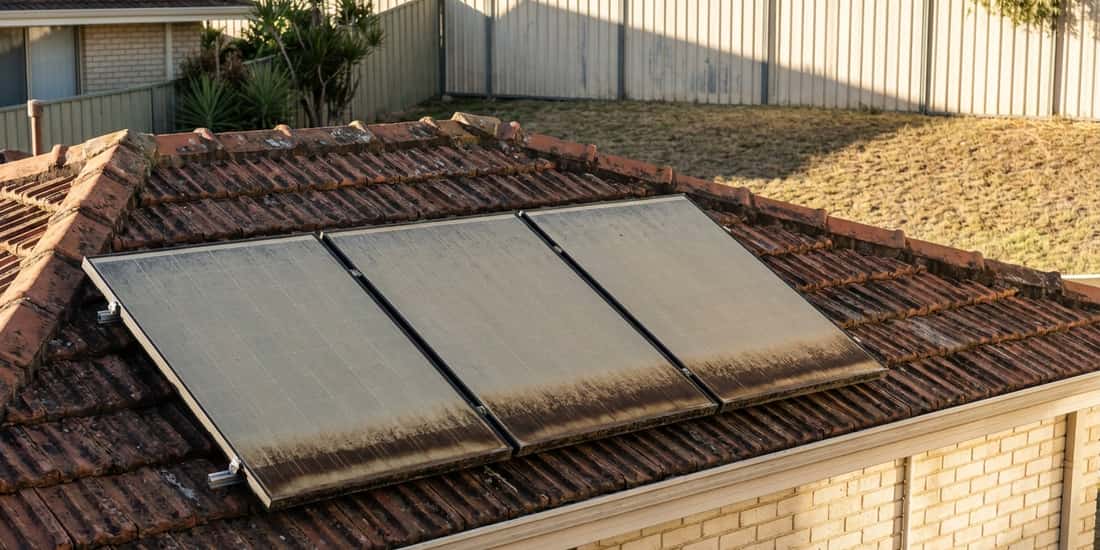
Rain is also a poor cleaner in practice. A light shower wets accumulated dust, mobilises it into a slurry, and then dries it into a streaky film that bonds harder than the loose dust did. On a low pitched roof, which is common on modern Perth homes, water sits rather than sheets off, and the film dries in place along the lower edge of each panel.
By the end of the first year most uncleaned arrays have a visible tide line of baked residue along the bottom frame of each module. This band matters more than its size suggests, because it shades a full row of cells. Modules are wired so a shaded row can drag down the whole string it sits in, which is why a narrow strip of dirt has a disproportionate effect on production.
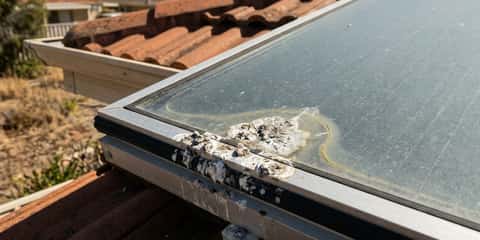
Bird droppings also start appearing in earnest, particularly under flight paths, near ravens and galahs, or where a nearby verge tree provides a perch. Fresh droppings rinse off. Droppings that have baked on a north facing panel through a Perth summer do not.
One to two years: the array stops behaving as one unit
Past the first year the picture becomes uneven, and unevenness is where real losses live. Some panels sit under a peppermint or marri and collect leaf litter and sap. Some sit in the lee of a chimney and hold moisture longer. Some are directly under a perch and take a concentrated hit.
Several things tend to be present by this point:
Organic growth. In shaded, damp corners, lichen and moss establish along the frame edge where water pools. Lichen is more than a shading problem. It grips the surface and holds moisture against the seal between the frame and the glass.
Bushfire and burn off ash. Perth summers reliably bring smoke haze, and prescribed burns add to it through autumn. Ash is alkaline and fine enough to work into every micro texture on the glass. It also bonds readily when it gets damp and dries again.
Salt crust. In Cottesloe, Hillarys, Mandurah and anywhere else within reach of the sea breeze, salt builds a crystalline layer that will not wash off with plain water. Salt is also mildly corrosive to the aluminium framing and to mounting hardware.
Bore water staining. This one is particular to Perth. A reticulation head that throws bore water across a low set roof, or a neighbour's sprinkler doing the same, deposits iron rich water that dries into an orange stain. Left over multiple summers, that stain becomes very difficult to lift.
Most of this is still recoverable with the right method, but not with a hose. The difference between a system cleaned at eighteen months and one left alone is usually the difference between a straightforward wash and a slow, careful treatment.
Three years and beyond: where damage becomes permanent
Somewhere past the two to three year mark, neglect starts converting into things that cleaning cannot undo.
Bird droppings are the main offender. They are acidic, and when they bake onto glass under Perth sun for successive summers they can etch the anti-reflective coating. The panel can be cleaned, but the dull patch stays and the coating's job is permanently compromised in that spot.
The second issue is thermal. A cell that is persistently blocked by an opaque deposit cannot convert light to electricity, so it dissipates the energy as heat instead. Panels have bypass diodes designed to manage this, but repeated hot spot cycling over years is a known contributor to laminate discolouration, seal degradation and, eventually, moisture ingress at the edges. This is not a risk from ordinary dust. It is a risk from something solid, opaque and stuck there for a long time.
Third, warranties. Most panel manufacturers require reasonable maintenance, and many installers include cleaning expectations in their documentation. If a module fails and the array has visible long term neglect, a claim becomes harder to make. Ironically, an aggressive catch up clean can cause the same problem, because pressure washing, scouring pads and harsh detergents damage coatings and seals in their own right.
What this means in practice
Never cleaning is not a cliff edge. It is a slow leak of production, punctuated by occasional events that leave a mark. The realistic outcome for a Perth home that never touches its panels is years of quietly reduced output, an array that no longer performs evenly across strings, and a handful of permanent blemishes where droppings or bore water were allowed to sit through several summers.
The good news is that the sensible interval is not aggressive. What it should be for your specific roof depends on how close you are to the coast, what is growing above you and how steep your pitch is, which is covered in more detail in our guide to how often you should clean residential solar panels in Perth.
If your array has been left for a few years and you would rather not find out what is under the film by climbing up there yourself, Purified Group’s Perth solar panel cleaning uses purified water and reach and wash poles, so the work happens from the ground and the glass dries without spotting.
Frequently Asked Questions
Does rain clean solar panels in Perth?
Rain rinses off loose dust, but Perth's rainfall is concentrated in winter when the sun sits low and output is already reduced. Light rain often makes things worse by turning dust into a muddy film that dries in place. It does nothing at all for bird droppings, sap or salt crust.
Can dirty solar panels permanently damage the system?
Yes, in some circumstances. Acidic bird droppings left baking on glass can etch the surface, iron-rich bore water can stain it, and a cell that stays shaded under a stubborn deposit can run hot enough to stress the laminate over time. Ordinary dust, by contrast, is entirely reversible.
How can I tell if my panels need cleaning without going on the roof?
Compare your inverter or app output against the same month in previous years, allowing for weather. A gradual decline that does not recover after rain, or one string consistently underperforming the others, is a reasonable prompt to have the array inspected.
Is it safe to clean my own solar panels?
The two risks are falling and voiding your warranty. Most Perth homes have tiled or metal roofs at a pitch that is unforgiving when wet, and pressure washers, scourers and household detergents can damage the anti-reflective coating or force water past the seals.
How often should Perth solar panels be cleaned?
It depends on your location, roof pitch and what surrounds the property. Coastal, tree-lined and semi-rural homes generally need attention more often than an inner-suburb roof with a steep pitch and no overhanging branches.